My interest is in the Elizabeth Burn who baptized her base born son Joseph Burn in Mary Tavy in 1806. We have long known that she is the mother of our progenitor but I have had some doubts that she is actually the Elizabeth Burn daughter of Roger and Susanna Bromblecombe Burn born in 1789 in Mary Tavy. Records have pointed this direction. The sister of this Elizabeth Burn, for example, is the informant for the death certificate of Joseph Burn. My central doubt has been around names since neither Joseph nor his children would reference either Roger or Susanna in the naming of any of their children– not necessary of course but remarkable nonetheless.
I am pleased to report that Elizabeth is proven as the daughter of Roger. It starts with the record of Elizabeth Burn who married James Unsworth in Plymouth, England in 1813. He is a member of the Royal Artillery. This caught my eye because I think it likely that the father of Joseph Burn met Elizabeth in Plymouth because he was linked to the navy. I am still not sure why this happened but Burn descendants appear to match with Dorset’s Joseph Hyde and the easiest way to make this happen is through the port city of Plymouth because Mary Tavy is just not a place that would have drawn a lot of folk outside of miners. I say more about this in the blog for Joseph Burn and Joseph Hyde.
James Unsworth and Elizabeth Burn have one child Richard James Unsworth born 1814 in Mary Tavy. So Elizabeth seems to have stayed in her home village, while her husband probably continued in the military. He died sometime before 1839 (but likely closer to 1814, since they did not have any more children). At that point, Elizabeth Unsworth, the widow, remarried to James Williams who was the widower of her sister Ann Burn Williams. The marriage record actually identifies her as the daughter of Roger Burn. Since Unsworth is not a local name, this is, as they say, a smoking gun, proving that this Elizabeth is the sister of Ann and Tammy and daughter of Roger.
and we can be pretty certain that she is the mother of Joseph but this is a little more inference. James Williams is found in the 1841 Census almost next door to Joseph Burn in Blackdown with his wife Elizabeth who is 45 and his daughter Ann and son Richard. Elizabeth Williams died in 1845. He then remarries 13 day apart from Joseph Burn’s marriage to his second wife in consecutive entries in the Tavistock register.
DON CARLOS WILMOT’S grandfather, also Don Carlos Wilmot, lived on Archibald’s (a relative) place. There is a hill named after him called “Don Carlos Wilmot Mountain” better known today as “Wilmot Mountain” in Thetford, Va. He was a 49er in the California Gold rush, having gone off to adventure with his cousins. “
He married Lucina A. Graham and lived in the house in which he was born in 1826,” {Gazeteer).
Don Carlos, the son of Joseph & Mary (Freeman) Wilmot, saved enough money to build his house in East Thetford, Vermont in which more than three generations of Wilmots were born. He always lived on the ‘Timothy Willmot’ farm. (From FindAGrave website added by Roscoe Wilmot in 2009)
A LITTLE EXPLORATION OF NAMES
DON CARLOS So where did the name “Don Carlos come from…Hmmm” 1) DON CARLOS, Prince of Spain by John Otway (1676) “…Elizabeth Barry was the mistress of JOHN WILMOT, Earl of Rochester, the poet to whom OTWAY dedicated “Don Carlos”, a heroic tragedy, his first success.” 2) A story I heard in Vermont is that there was a particularly bad year when the only sheep that survived had been gifts of DON CARLOS of SPAIN. Many children were thus named in his honor. Vermont records of the time reveal at least seven Don Carloses born between 1789 and 1823: Barrett (1789 Norwich), Mather (1800 Jericho), Hatch (1800 Brookfield), Hunt (1801 Norwich), Wilmot (1811 Thetford), Hawley (1811 Cambridge), Luce (1823 Stowe). None of these have a known relationship to DON CARLOS WILMOT. If we take the locations, they appear to be in two clusters: Norwich(A), Thetford (B) and Jericho (C); AND Jericho (D), Stowe(E), and Cambridge(F) .
One reads in the Vermont Visitor of 1845, that Don Carlos (infante Carlos 1788-1855) abdicated his thrown in honor of his son. This would mean the first Don Carlos was born about roughly the same time so could not have been named after the Infante, but could have been named after his father, Carlos IV, who ruled until 1808.
Introduction of the Merino probably occurred in 1793. In 1801, a Merino sheep called the “Don Carlos” was bred along the Hudson. Apparently, one William Jarvis of Vermont, US consul to Portugal in 1809/1810 shipped more than 4000 merino sheep to the US and a mania for Merino sheep began to develop (Livestock production and marketing-Google Books).
So, this sheep connection cannot explain everything. It could be that Hunt, Wilmot, Hawley and Luce are actually named after the 1801 sheep came to the US (thus popularizing the junior Don Carlos. But the naming of Barrett before 1793, when the first Merino sheep cam to the US does not fit.
ARABELLA KINGSBURY “Kingsbury” is a family name that followed on the Moor side. Kingsbury Moor (see http://adupree.com/wp/g/getperson.php?personID=I818&tree=adupree ), Arabella’s great aunt (uncle?), is the first I have found to fit the name. But I have found little about his life to show why the name would merit repeating. Arabella’s cousin William Kingsbury Moor (see http://adupree.com/wp/g/getperson.php?personID=I397424&tree=adupree ) is another to hold the name.
JOSEPHINE MONTAGUE ???
HERBERT G No known Herberts in family. G could stand for Graham?
HAVILAND GEORGE There are Havilands in Danville. Charlotte, for example, married there Joel Sanborn and named her daughter Charlotte Haviland Sanborne. Is there a link to this family of Wilmots?
CHARLES SOUTHWICK In 1855 (census) a certain Kimball T Howe (b 1828 NH s of Nathaniel & Rachel Coburn) and his wife Levinia/Valina (b 1836 MA)were living in Middlesex county, Massachusetts. Living with them was 18-year old CHARLES SOUTHWICK a bootmaker from Connecticut. Since Don Carlos and Lucy certainly worked in Lowell, Massachusetts, is it possible that this is the namesake of CHARLES SOUTHWICK WILMOT?
It is intriguing that there Kimbell Howe also has a daughter JOSEPHINE (1856) and a son HERBERT (b 1867) and a Lucinda (b 1854). Kimball was a greenhorn crew member about the Triton a whaler bound for the pacific in 1849. What is, if there is any, the relationship to Don Carlos Wilmot and Lucy Graham?
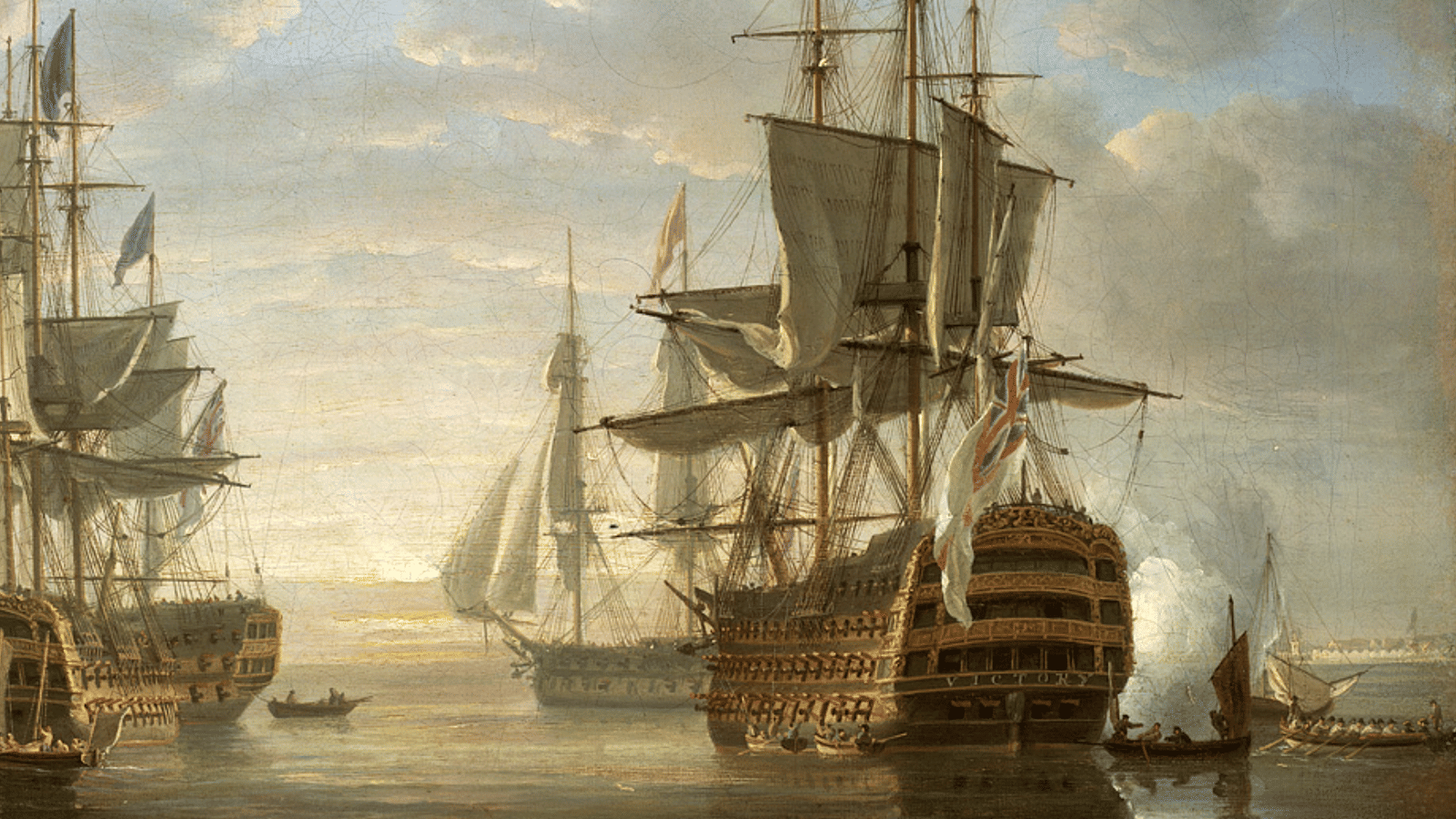
Royal navy ships in the Battle of Trafalgar – 2 Oct 1805
In 1806, in Mary Tavy, Devon, Joseph Burn was born out of wedlock–a fact that undoubtedly made his life difficult. The certificate for his second marriage, for example, clearly states “base born” for both him and his wife. It also threatens to make him a genealogical dead-end.
However, It has been possible to piece together a plausible theory about his origins, even if I have not been able to prove it to date.
While his mother was Elizabeth Burn; she was not the only one of that name in Mary Tavy. There were at least two Elizabeth Burns of the right age born in Mary Tavy around the right time. Nevertheless, because Tammy Burn Skelly (the sister of Elizabeth by father Roger Burn) signed Joseph’s death certificate, was a close neighbor and seemed to maintain otherwise close ties to the family, it seems likely that she was Joseph’s aunt and my own database makes this connection.
Who was Joseph Burn’s Father?
Joseph’s potential father might seem like a real dead-end. No record of a bastardy suit has been unearthed (such a record was very helpful for unearthing a hitherto unknown child of his grandson, John Lloyd Burn, for example.) However, it is possible to dream a rather far-out theory.
This all started with an autosomal DNA match to my mother in an Ancestry DNA test. The match is 32 centimorgans–relatively significant. Ancestry reports this is a predicted relationship of 4th to 6th Cousin. For comparison, some of my mom’s cousins who are direct descendants of Joseph Burn, and for whom I can count on well-confirmed paths match at 32cms or below. I knew because of shared cousin matches that this match was on the line of Joseph Burn. This is useful because I could focus on Joseph himself, the Burn lines and, ultimately, as none of those lines coincided with anything in this person’s tree.
Yet, that was a challenge even narrowed down to the Burn family because nothing, no nothing looked familiar. The first issue is that this tree had little in common with mine geographically. There were almost no families in the Southwest of England (from whence originate the Burns) in this person’s trees. Since along some lines of the Burn family it is said that Joseph Burn “came from” Scotland, I focused on the Northern England and Scotland lines of this family. But I came up cold. The tree also has a little corner in Cornwall. Excitement was short-lived; nothing connected. OK, that took me a long time.
What I know about Joseph Hyde
The naming of Joseph’s children is a big clue. Joseph names his first two sons, John Lloyd Burn and Josiah Princemeet and his grandson was named Josiah Prince Frederick Burn. As it is tradition to name the first born son after the father’s father, it is possible that Joseph’s father was a “John Lloyd.” This name is also repeated for several generations. At one point, I found a local John Lloyd, petty gentry, within the proximity of Mary Tavy. But after collecting wills and all the records around the life of this fellow, I concluded that a connection, at least to the father of Joseph Burn for whom I was searching was highly unlikely.
That took me back to basics. Elizabeth Burn named her son “Joseph,” a name that was neither her father’s nor any of her brothers’. Soooooo, in maybe bad form, let’s start the inquiry by raising the possibility that the base born boy was named after a father, also named “Joseph.” That led me to a Joseph Hyde in the online tree, the father of a Sarah Hyde who are on the tree’s direct line. By the way, I am avoiding giving the name of the tree’s contributor.
This Joseph Hyde lived in the county of Dorset, where I have done relatively little research in the past in an a small farming village called Shipton Gorge. I even had a moment of realizing that Dorset is the next county over from Somerset and by sea not far from Plymouth. Let’s look at what is knowable about this Joseph Hyde.
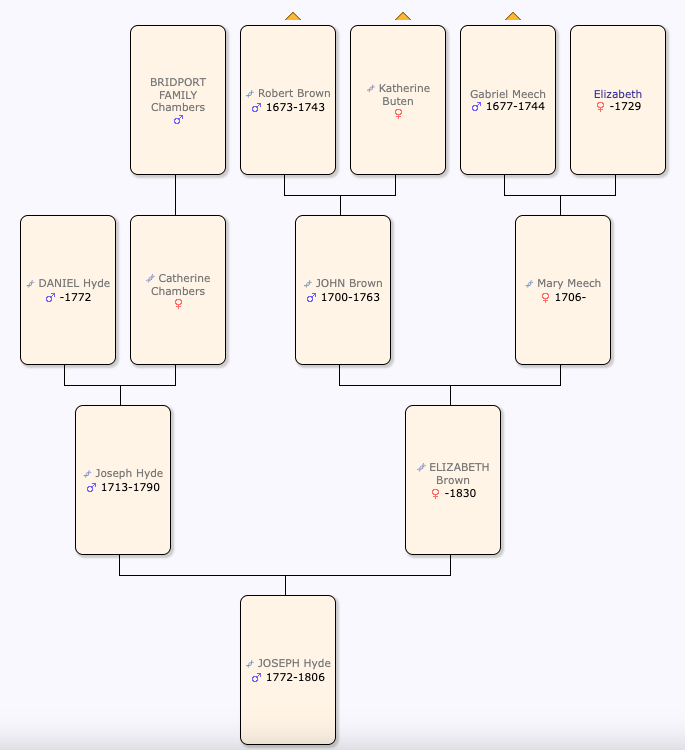
Joseph Hyde senior was born in Burton Bradstock in 1773 to a family with property and history in Shipton Gorge. He had four children, the twins Catherine and Sarah (1766), Betty (1769) and Joseph (1772). His will, written probated between his death in 1790 and 1807 leaves bequests to his daughters Catherine and Sarah and his son Joseph Jr who is under 21 years old. Apparently his daughter Betty has died before this since she is not mentioned.
20 Jan, Under 100 lbs, Abstract of will of Joseph Hide, the elder, yeoman Joseph Hide of Shipton Gorge, executor My son of Joseph shall attain the age of 21 years Sarah Hide, daughter Catherine Stone, daughter I give and bequeath unto my nephew Joseph Hide in trust for my son Joseph Hide all the residue and remainder of my estate and effects whatsoever and wheresoever. (Accessed Dorset Archives Online)
The nephew in the will, I believe is, the son of Joseph’s brother Edward Hide. This is important because in the next probate record we find Joseph Jr., a bachelor, has apparently passed away by 1806, leaving his cousin Joseph (son of Edward) with his property.
1806 Shipton Gorge 18 Oct, Under 300 lbs, Joseph Hide, bachelor. Joseph Hide of Shipton Gorge, the lawful cousin and next of kin, administrator. (Accessed Dorset Archives online)
Thus, Joseph Hyde Jr died young several months before Joseph Burn was baptized in Mary Tavy, Devon. Joseph Burn was baptized the 21st of September 1806, with a little math we can imagine that he was conceived around 21 December 1805. Whoever his father is would have had to be in the proximity around that date.
What opportunity would Elizabeth of Mary Tavy have to meet Joseph Hyde?
Mary Tavy is a small mining village on the western edge of Dartmoor about 18 miles from the city of Plymouth to the south. Plymouth was a major shipping and navy port with industry that revolved around both shipping and war activities. I can imagine that for Elizabeth Burn it was the big cosmopolitan city. It is hard to know exactly, Tavistock, was much closer, but I imagine that in 1806 Plymouth was quite a draw. I know I found a record that suggests that she may have lived in Plymouth in 1805. I will have to locate it. If Elizabeth were in Plymouth, of course, she could have met people from across England and the world. She could have met a young Dorset-born sailor named Joseph Hyde.
To take this further in 1805, there was a war raging in Europe. The British had just turned back Napoleon at the Battle of Trafalgar in October 1805. The battle involved around 300 British ships and the famous Horatio Nelson lost his life aboard the HMS Victory. Many other marines were killed or wounded in the battle as well. They were brought to navy hospitals in Britain. One of these was in Plymouth, called the Royal Naval Hospital (Stonehouse). Among the hospital ships in the Battle of Trafalgar was the HMS Prince Frederick (there is probably a full list somewhere, but a quick search shows that this ship was, in fact quite active in this period of time).
We also know that the HMS Prince Frederick was in Plymouth Dock from 1803 to 1815:
17 Apr 1803 was commissioned at Plymouth Friday last, as a receiving and convalescent ship for recovering convalescent seamen and marines sent from the Royal Naval Hospital, [Stonehouse ?], previous to their being put on board their respective ships. May 1805 Plymouth Navy Office 19 Jul 1816 Lying at Plymouth ; offered for sale for 31 Jul 1816. 28 Aug 1816 lying at Plymouth ; offered for sale (source: https://sites.rootsweb.com/~pbtyc/18-1900/P/03641.html )
In a war, hospitals become overwhelmed and they tend to engage young woman as employees or volunteers to help care for the wounded.
I suspect that 17-year old Elizabeth Burn might have been among the volunteers at the Royal Naval Hospital. Perhaps she travelled the 19 miles from Mary Tavy and lived with a family member or friend (or stayed in a boarding house). This hypothetical can place Elizabeth in Plymouth from October 1805 to March 1806. Now she would have had the reason to meet quite a few sailors, wounded or not, from the British fleet. I am thinking that, perhaps, one 26-year old Joseph Hyde had become a sailor at some point. Perhaps he was at the Battle of Trafalgar and was wounded. His time in Plymouth would have been for recovery. One possibility is that he succumbed and died in Plymouth by end-of-March. In this scenario he could not have been too wounded for a tryst. Of course, he could have recovered and gone back out to the war, dying shortly thereafter. While I have found no proof of a Joseph Hyde among them, I know that the Royal Navy Hospital in Plymouth had many wounded marines as evidenced by the wills below. There are lists at the UK Archives of the patients and staff; unfortunately, they have not yet been scanned but accessing them might be a next step.
1806 Wills left at the Royal Naval Hospital in Plymouth. John Blade, of the HMS Prince Frederick left his will in March 1806 to his family in Norfolk and Felix O’Neal, of the HMS Prince Frederick left his will in March 1806 to his family in Sligo, Ireland.
For a long time, I thought that the names “Princemeet” and “Prince Frederick” referred to perhaps an event where someone in the family, perhaps Elizabeth Burn, met with Prince Frederick, Duke of York and Albany (1763–1827), who was a British field marshal and second son of King George III. Princemeet would thus commemorate meeting the prince an Prince Frederick would be in honor of the man. Perusing the life of this historical figure, however, led to nothing. Except, it did make sense that the father of Joseph Burn was likely in the navy as the simplest way in which the prince could have been met.
Whenever I was hunting for information on Prince Frederick, I would see but ignore information on the ships–there were at least three that were named after this man. But it could make sense that Elizabeth met a sailor, say Joseph Hide, while his ship, say the HMS Prince Frederick, was in Plymouth dock. Looking through the history of these ships and searching the UK National Archives, I found that the HMS Prince Frederick could have been at Plymouth Dock in the end of 1805. At least, the following records might place it there between August 1805 and March of 1806:
I imagine Elizabeth working at the hospital under the supervision of a John Lloyd. I know he was a “clerk” but beyond that it is just my desire to explain every loose end.
For any of this to make sense, Joseph Hyde would have had to be in the navy in this period. I have found no proof of this. On the other hand, the British navy was very active in 1806 with significant casualities (This Wikipedia wiki documents some of the Atlantic campaign of 1806). It is quite possible that someone like a young Joseph Hide never returned home from a battle at sea.
Back to the DNA
So far this is a just a story, with scant records and certainly no proof. Starting from an autosomal match, eliminating much of the possibilities on that line and pursuing one of two Josephs (the other was far away and of much higher class), and then seeing if I could tell a story that would fit within the very odd naming clues, that is where I arrived.
Armed with this story, I began to fill out the family of Joseph Hyde of Shipton Gorge and his wife Elizabeth Brown. I must say, that there are many links low confidence here and many Joseph Hydes! But on the whole, using wills and parish registers, I think it is a reasonable telling going back three to four generations.
When this task was complete, I returned to the cousin matches on Ancestry and began to look in the unmatched Burn family matches of my mom for missing links. Here I was quite pleased, I found 12 matches that suggested distant cousins through Joseph Hyde (trying to scour each to make sure there were no other matches. Of course, no tree is complete but I found that a combination of two factors–a person was a shared match with my known Burn cousins, and their tree included this small region of Dorset, gaive me some confidence). The centimorgans range from 9 to 32. Out of the twelve matches, three link to the Brown family and eight link to the Hyde family of Burton Bradstock/Shipton Gorge. That led me to a Joseph Hyde in the online tree, the father of a Sarah Hyde who are on the tree’s direct line. By the way, I am avoiding giving the name of the tree’s contributor.
This DNA proof has two related issues. The matches tend to be at the top of or slightly above Ancestry’s predicted range. For example, my two matches of 32 cms have a predicted range of 4th-6th cousins (meaning my mom should be a cousin of the test taker within that range). But in one case she is a 7th cousin and then other she is in the range as a 5th cousin. And the second issue is that I have not been able to recreate the original Ancestry tree that led me to Joseph Hyde to begin with to my satisfaction.
Conclusion
All of this leads me to a conclusion that Joseph Hyde is a good bet to be the father of Joseph Burn…if he was in the navy…if Elizabeth Burn was in Plymouth in 1805…if he died, perhaps never knowing that he had a son born in Devon.
The accepted but not proven parents of Cassandra Burnell Southwick are Humphrey and Ann Burnell of Bearley, Warwickshire. This has seemed problematic to me for a number of reasons, primarily that Cassandra names none of her children Humphrey or Ann.
I started on a path to question this lineage by noting that the second known son of Cassandra and Lawrence Southwick is born in Kingswinford, not surviving to adulthood, and is named Ananias Southwick. Anianias is baptized 1 Sep 1627 and buried 17 Sep 1627. This unusual name will then reappear on one of the few early records of Lawrence Southwick in Salem when Ananias Conklin, Obadiah Holmes and Lawrence Southwick set aside 2 acres of land for one of the first glassworks in 1639.
Ananias Conklin is also from Kingswinford, where he baptizes the children in his family (Mary, Jeremy and Cornelius). The last baptism is in 1637, two years before the Salem record. We do not know the parents of Ananias, although some suspect he is the son of a William Conklin or it could be a George Conklin.
This uncommon name “Ananias” only appears on a few records in the Kingswinford region, which includes the town of Old Swinford:
C1617 Ananias Southwick s of Lawrence and Cassandra C1618 Ananias Henslee s of Josua, glassblower Oldwinsford C1613 Ananais Arche son of Thomas Arche C1637 Cornelius Co[nu]clen son of Annumus
This region is the site of glassmaking, where the Henzey family plays a significant role. Joshua Henzey is the son of one Ananias Henzey from the Lorraine region of France, whose family would feature. While Ananias’ son is clearly there, he leaves his will in 1660, his father Ananias is not found in any extant records. But I believe he is the possible father of Cassandra.
Cassandra Burnell marries Lawrence Southwick of Kingswinford in 1623 in
Captain Christopher Clark of New Kent, Virginia is a direct ancestor for many people, including me. As such he has been the subject of much good research and speculation. I was struck by the lack of proof for the path that has oft been proposed – that he is a son of Micajah Clarke and Sallie Ann Moorman. For many years, I have left this as my own path of choice, given the naming of a second son Micajah and the many links to the Moorman family.
But Micajah may or may not have existed. I did find one Micah Clark born to Miles Clark in 1607 in Great Bromley, Essex. But little to nothing in Virginia or in Barbados where Christopher Clark is said to be from.
So here is where I start – I theorize that the Barbados origins may have the element of truth, given the preponderance of name matches in Virginia. This perhaps is too big a leap, but drawing from Linda Sparks Starr and others it seems a good bet. Working from this, I have managed to identify a place of English origin in Sandwich, Kent County, England. As it stands I am pretty certain this is a promising path, but also clear that I have not proven it.
Step 1: Research and go deeper in the Barbados Clarks.
Using baptismal records and wills (largely available on familysearch.org, which I will denote with an FS), I find that there are really two candidates for Christopher Clark of Virginia, the grandsons of Christopher Clark who died about 1695 according to his will in Christ Church parish, and sons of Micheal and Roger Clark. By the time that their grandfather died there may have only been one of them still in Barbados as Christopher only mentions one grandson named Christopher.
The Patriarch, Christopher Clarke Sr. (c1620-1695), and his wife, Ann, had four sons and one daughter who survived to adulthood. Christopher Sr. outlived his wife and all children except daughter Elizabeth Trescott. He named in his will (per _Barbadoes: Wills and Administration_) daughter Elizabeth, a grandson Christopher, granddaughter Ann who was dau of deceased son Thomas, a friend and a god-son. Linda Sparks Starr 1996
The Christopher who is still in Barbados married Sarah Patterson in 1694 and presumably died in 1701. Both of the Christophers are born around 1670. The son of Roger has a baptismal record in Christ Church for 29 Sep 1670 (FS). The other, the son of Michall has no baptismal record but is mentioned in his father’s 1679 will.
Michall Clarke, planter. Christ Church Parish, 14 Jul 1679 Bro Roger Clark, Chn Christopher Clark, Ann Clark & Elizabeth Clark, kinsman John Sadbury’s chn John Sadbury, Joshua Sadbury, Kaleb Sadbury, & Susan Sadbury, wife Eliza Clarke..xtr..bro Thos Clarke, sis Ann Clarke, sis Elizabeth Clark, godson Owen Melloney, friends Robert Robertson, & Thomas Luce overseers, signed Michall Clarke, Wits John Stone, Edward Wright, proved 19 Aug 1679 Barbados Records
He may be missing from the Barbados records or baptised elsewhere (although I could find no records for any of Michall’s children all of whom are born sometime before 1679.) Perhaps somewhat randomly, I think this Christopher is the Captain Christopher Clark of Virginia. His mother, Elizabeth, may remarry to George Sheares in 1688 in Christ Church (FS) but there seems to be no more footprint for George and Elizabeth Sheare after this time and no clear marriage records for the daughters mentioned in the will. So, recap, If Christopher is connected to the Barbados families, then he is a son of either Roger or Michael. He also could be the Christopher who marries Sarah Patterson, who also is not later in the Barbados records.
With the above sorting and links to Sandwich, this diagram illustrates the connections to Richard Clark:
Step 2: Where do the Barbados Clarks come from?
This may seem hard to answer but what helped me a lot was this record that strongly suggests that Christopher (the grandfather above) of Barbados is the son of a Richard Clark.
The Will of James Burston, 21 Jun 1653 ….CHRISTOPHER CLARK son of RICH CLARK, xtr, (executor) Barbados Records
I think this may be the first incidence I have ever found where the father of the executor is mentioned. Christopher is clearly an adult and old enough to be an executor. So what was James Burston trying to say?
With a probable father for this Christopher Clark I set out to see just how many Christopher’s sons of Richard were born in England around the same time. Not many. I found this one, Christopher Clark, baptized Feb 1619 in Sandwich St Mary, Kent, England (FS). But what was amazing is that many of his brothers can then be found in Barbados in the same time period: William Clarke, bp. 1608; Richard Clark, bp. 1615; John Clark bp. 1622 — And then, perhaps, a few for whom I have not found baptism records in Sandwich: Francis Clark bp 1626 in London, Robert Clark and Thomas Clark.
Up to this point I have only name matches with Sandwich. But then there is the case of Robert Clark Jr who I have identified only through his will.
Robert Clarke, Jr 8 Sep 1655 …John Walker, Thomas Holdridge my apprentice-freedom. Thomas Smith, daus Elizabeth Clarke, Massey Clarke & Jane Clarke & Sons Burrough Clarke & John Clarke, all chn at 21, William Withington & George Horton xtrs & gdns to send children home to England if they see fit to Arthur Barker & Thomas Barker, uncles of the chn., now living in DARFORD of KENT. Signed Robert Clarke. Wits John Walker, Stephen Bancks. Proved 12 Sep 1655.(Barbados Records)
The fact that he is identified Jr could mean he is the younger Robert in Barbados but this would not make any sense because the other Robert (possible son of Christopher) would be much younger. In this case, I believe that he is a Robert Jr and can be identified in the Kent records as Robert son of Robert bpt 1611 in Canterbury Kent. This would make him the brother of Richard Clark and uncle of Christopher Clark found in Barbados. The son Burrough is a key because there is only one, Burrough Clark, bpt in 1641 in Cranbrook, Kent (FS). In fact all children mentioned in his will are found in Cranbrook, Bromley and Dartford, Kent. Dartford is important because it is clearly mentioned in the will as “Darford.” And, thus, we have added evidence that the Clarks of Barbados come from Kent County.
All of this, by the way adds up to a family progenitor in Sandwich named Robert Clark who was born about about 1562 and may have been married three times. A Robert Clark is clearly named as the father of Richard Clark in Sandwich and Robert Clark in Canterbury (FS). However, I have found no other children.
So my conclusion is that Christopher could come from Barbados from a family of Sandwich. And I think this is more likely than that he is the son of a Micajah Clark. Naming may also add some weight to this. This Christopher, son of Michall, may have never known his father. He could have been raised by his Uncle Edward Clark who died in 1687 in Barbados, for whom I have found little information outside of Barbados vital records. He could also be an unknown son of this Edward, whose known wives were Catherine and Margaret. But he does not name any known daughters by these names. He does name a daughter Elizabeth, who could be named after the wife of Michael, the father I am proposing. His son Micajah could reflect his father Micheal although there is no evidence that Michael (spelled Michall) was called by this name.
Tracing the history of William H McNalley and his brother Thomas in Cleveland, Ohio, the following analysis of McNalley (McAnnelly, McNally, McNeil, McNelly, McNelley) addresses may suggest that most of the McNalley families from the 1830s to the 1860s in Cleveland are related to each other. It points to two early McNalley progenitors — Thomas and Henry McNelley. They have a close relationship that could be as siblings. The Thomas and William I am tracking seem likely to be sons of the elder Thomas and nephews of Henry McNalley. Examination by address follows here:
A Thomas McNelly lived on 53 Parkman from 1845 until he died around 1856.
It is likely that Charles who is listed in 1848 is his son (but, of course, could be another relation). We might also suggest that Thomas McNelley, Jr in 1857 and, perhaps 1849 is his son. Following this logic, we might suggest that Wm McNalla on 32 Parkman in 1853 could be his son as well. We conjecture this is Thomas’ brother, Capt. William H. McNalley who is married the same year. More below on both Thomas and William.
After 1856, his widow is listed on 61 Parkman.
Thomas McAnella
1845
Laborer
53
Parkman
City Directory
Thomas McNelley
1845
Laborer
53
Parkman
City Directory
Thomas McNelley
1846
Laborer
53
Parkman
City Directory
Charles McNelly
1848
Laborer
53
Parkman
City Directory
Thomas McNalley
1849
50
Parkman
Tax Assessment
Thomas McNalley
1852
Parkman
Tax Assessment
Wm. McNalla
1853
Beef, pork on Canal
32
Parkman
City Directory
Ann McNally
1856
Wid of Thomas
53
Parkman
City Directory
Thomas McNelley
1857
59
Parkman
Tax Assessment
Mrs McNalley wid Thomas
1859
61
Parkman
City Directory
Mrs McNelley
1861
Widow
61
Parkman
City Directory
This Thomas could have been the same man who is on a tax record with Inad Kelley in 1837 on Bank Street. The name with Irad looks like Thomas McNelley… but it could also be Thomas M Kelley, which seems more likely.
In 1840 Mrs. E McNelly is listed in the census with 8 males (1 under 5, 1 15-20 and 6 20-30). I think it is most likely that this is a boarding house
Clearly William (who would have been 11) does not fall in this age range. But there are also an interesting 3 members of the family who are engaged in Lake, River or Canal navigation according to the census. Is it possible that Thomas Sr and some of his boys are not accounted for because they are not in Cleveland but are on ships?
Between 1849 and 1863, it is likely that Thomas Jr lives on Parkman, Orange and Cross. There are no other McNelley’s at Orange or Cross. The 1857 tax assessment on Kinsman is interesting because it links Thomas to Peter McNalley, perhaps another son of Thomas Sr who would be Thomas’s brother.
There are at least three William McNelly (and variants) living in Cleveland in the time period. It looks like William (brother of Thomas) is found first with his brother in the hotel of George Thompson on (perhaps) Union Lane. He might be the Wm. McNella found at 32 Parkman, but this does not identify him as a Sailor, so I think it is unlikely. He seems to be found next at 329 St Clair and then 435 St Clair. St Clair is connected with the family of Henry McNally. Henry’s son William was born in 1820 and I have not been able to track him. So it looks to me like William is living in the same region as his Uncle? Henry McNelly. He then moves to his permanent address at 38 Fulton by 1863.
William McNelley
1850
Sailor
Hotel Ward 3
Census
William McNelly
1851
Tax Assessment
Wm. McNalla
1853
Beef, pork on Canal
32
Parkman
City Directory
Wm McNelly
1856
Seaman
329
St Clair
City Directory
William H McNalley
1859
435
St Clair
City Directory
William H McNelley
1859
Captain
435
St Clair
Newspaper
William H McNalley
1861
435
St Clair
City Directory
Wm. McNally
1861
Sailor
34
Fulton
City Directory
William H McNalley
1863
Fulton
Tax Assessment
William H McNally
1863
Sea Captain
38
Fulton
City Directory
We have already looked at the Parkman McNalley’s, we move now to look at St Clair.
Tracking St Clair McNalleys
Henry McNalley is found from 1848 to 1852 on St Clair. The actual address is not listed. He apparently died before 1857 when Catherine McNally is found at 147 St Clair. However, Catherine is only listed as a widow in 1864, so it could be that Henry is not living at home.
Joseph McNalley is not listed in the 1850 Census that names the children of Henry and Catherine (Wm/1820, Daniel/1824, Henry/1826, Samuel/1828, Jane/1830, John/1833, Mary Ann/1834 and Patrick/1837). However, Joseph shows up at St Clair 1845/1853. He is a Drayman (someone who delivers beer). This could be interesting since 1850 Thomas (above) works in a bar.
Henry in 1856 could be the child of Henry and Catherine. He may be the H. McNeil, sailor, which would add another McNalley to the Great Lakes shipping business. Samuel on St Clair is also likely to be a son of Henry and Catherine.
William McNelley on St Clair from 1856 to 1861, is most certainly not the William son of Henry and Catherine. That William was born in 1820. The William on St Clair is verified by an 1859 newspaper article about the kidnapping of Oscar the son of Capt McNalley. William is not living at the same address as any of the Henry and Catherine McNalley family but he is on the same block with them. This could be a coincidence of course, but it does seem to suggest a close connection. I am surmising it is a good bet that Henry is William’s uncle…or close cousin.
Joseph McAnella
1845
Drayman
St Clair
City Directory
H. McNalley (w J Murray)
1848
St Clair
Tax Assessment
Henry McNelly
1848
Laborer
St Clair
City Directory
J McNelley
1848
25
St Clair
Tax Assessment
Joseph McNelly
1848
Drayman
189
St Clair
City Directory
H McNalley (w J Murray)
1849
St Clair
Tax Assessment
Joseph McMalley
1850
Drayman
St Clair
City Directory
Mr. McAnnelly
1850
St Clair
City Directory
Child of Joseph McNelley
1852
St Clair
Death
H McNeilly (w J Murray)
1852
St Clair
Tax Assessment
H McNeil
1853
Sailor
St Clair
City Directory
Joseph McNally
1853
Carriage Driver
187
St Clair
City Directory
Henry McNelly
1856
St Clair
City Directory
Wm McNelly
1856
Seaman
329
St Clair
City Directory
Catherine McNalley
1857
147
St Clair
Tax Assessment
Samuel McNalley
1859
Grocer
428
St Clair
City Directory
William H McNalley
1859
435
St Clair
City Directory
William H McNelley
1859
Captain
435
St Clair
Newspaper
Catherine McNally
1861
147
St Clair
Tax Assessment
William H McNalley
1861
435
St Clair
City Directory
Mrs C McNally
1864
Widow
401
St Clair
City Directory
There are more records that track Henry and other families on Kinsman
Autosomal DNA – that which identifies cousins – has proved particularly useful to me in adding verification of family members that I have researched based on records, family stories and more. Since there is always a possibility that a child listed in the census or baptized is not actually the child of the recorded parents, it does seem to add a level of certainty to the mythic past.
While DNA evidence is pointing in the direction of the Proulx family, I find no supporting records to back it up. I would be gobsmacked if it were wrong, however, the link is not proven.
But I have also made forays into finding parents of dead-end ancestors. This is, I believe, dangerous because one relies on the accuracy of other family trees and it is always possible that any conclusions are incorrect. That said as a disclaimer. I am relatively confident that I have identified the family of Felix Perew — for whom I have very few records and mostly the word of his children.
Felix Perew and his wife lived in the Plattsburgh region of New York. Both died before their son Frank was 16 years old, leaving young children who stayed in the region. Census records capture them later on as does the will of Frank Perew. They are, however, hard to find in the 1800 through 1840 censuses that, of course, only list heads of families. Frank Perew became a steamship captain and even launched a ship called the Mary Elizabeth Perew. The ship could have been named after his sister Mary E Perew who married William McNalley, also a steamship captain. Or it could have been named after his mother — I think more likely and so I have suggested that Felix Perew’s wife was likely a Mary Elizabeth.
Now here is where DNA becomes interesting. I have recorded 29 DNA tests that point to the family of Jean-Baptiste Seguin dit Laderoute and Marie Marguerite Leduc. This raises the probability that Felix Perew’s wife was from this family, and, hence, with the name Marie Elisabeth Seguin (Perew). At the same time, 24 DNA tests suggest a strong link to the family of Jean-Baptiste Proulx and his wife Marie Felicite Lecompte dite Lafleur. I believe these are probably parents of Felix Perew – Proulx.
In each of these cases, DNA tests identify cousins with all the intermarried families. In the numbers listed above, some are descendants each generation back. While it does seem that there is significant inter-marrying among the French Canadians, the DNA seems to converge in a way that is highly suggestive. But, a caveat, not proof. Here are the Generations and linking tests (identifying cousins among the descendants of each family. I start with Mary Elizabeth Seguin.
Mary Elizabeth Seguin – b about 1797 in Quebec province.
Gen 1
Jean Baptiste Sequin dit Laderoute and Marie Marguerite Leduc
Matches to descendants of 4 children: Jean Baptiste, Josephte Robillard, Thomas Seguin, Joseph Seguin.
M1 – 5th- 8th Cousin (15cm) – is a 5th Cousin Once Removed (of test taker)
M2 – 5th-8th Cousin (11cm) – is a 5th Cousin Twice Removed
M3 – 4 associated tests: 1 – a 5th cousin (27cm), 2 – a 5th cousin (28cm), 3 – a 5th cousin (30cm), 4 – a 5th cousin (26cm)
M4 – 2 associated tests: 1 – a 4th cousin once removed (32cm), 2 – a 5th cousin twice removed (30cm)
Gen 2
Jean Baptistie Seguin dit Laderoute and Marie Josephte Lemadeleine
Matches to descendants of 1 child: Therese Seguin dit Laderoute Bray. 6th Cousin once removed (14cm)
Joseph Leduc and Marguerite Brigitte Lalonde
Matches to descendants of once child: Marie Josephte Leduc Pilon: 6th Cousin (34cm)
In fact, matches continue going back two more generations and more, albeit becoming weaker as one would expect. Full ancestor chart for Mary Elizabeth Seguin Perew is shown here – https://adupree.com/wp/g/verticalchart.php?personID=I386895&tree=adupree&generations=
I have found no baptism record or any other mention that clearly places Mary Elizabeth in this family. But I have discounted other Mary Elizabeth Seguin’s born around that time. Although they are related, they do not continue to relate going back. The only baptismal record for a Marie Elizabeth Seguin I have found is the child of Hyacinthe Seguin and Mary Louise Roulou. See link. While many ancestors of this Marie Elizabeth Seguin are the same – there is much less to point to this family. Still, since there is evidence of a Marie Elizabeth… I will keep looking.
Felix Perew/Proulx b 1780/1790 Quebec
Gen 1
Jean Baptiste Proulx and Marie Felicite Lafleur (and his first wife)
Matches to descendants of 4 siblings: Jean Baptiste, Michel, Joseph and Antoine
Joseph Lecompte dit Lafleur and Marie Ursula Louise Chevalier dit Marquet dit Perigord
Matches to descendants of 2 siblings
M1 1 test: 6th cousin once removed (9cm)
M2 1 test: 6th cousin once removed (8cm)
***
Because there were so many matches I choose to not record the second matches to the same families. So there is at least double what is listed here. There are a few descendants who can also be tracked to upstate New York, such as Jean-Baptiste Seguin (son of Thomas, son of the Jean Baptiste Sequin above), who died in Ogdensberg, New York in 1906. But besides the happenstance inferences, I can find no paper trail to PROVE this DNA line. Nevertheless, I think it is highly probable.
The main conjecture here is the central fungibility of the name “Birchfield.” Spellings or forms included in this analysis include Burchfield, Birchell, Burchell in one, relatively well documented assertion. And then Bickhill, Boucher and Butcher as it gets a little more interesting.
In 1686, one Adam Birchell/Burchell patents ‘the Garden of Eden” in Harford County Maryland. The next year, he patents “Eden’s Addition” also in Harford.
“The Garden of Eden” 1 Apr 1686 150a 150a Adam Burchell ” Patent NS#B:426 67-3F
Patent 8 Sept 1687 “Eden’s Addition” 22:288 11 June 1685 Adam Birchell 100a 100a
This Adam has died before 1694 and one James Phillips is the administrator of his will.
Bond of James Phillips administrator of Adam Birchell. Securities Simeon Jackson, George Smith Also inventory by appraisers Simeon Jackson, George Smith
What is important is that the Eden’s Addition is sold in 1704 by Thomas Burchell.
Nov. 13, Baltimore Co., deed, Thomas Burchell, to Cadwallader Jones, for 100 acres of Eden’s Addition”. 0R, #PP: 134.)
This is pretty good proof that Thomas Burchell is the son of Adam Burchell of Eden’s Addition. By 1718 in Harford County one Thomas Birchfield patents Thomas and Mary’s Repose:
“Thomas and Mary’s Repose” 1718 100a 100.3a Thomas Birchfield ” Patent FF#7:377 67A
And in 1724, one Adam Birchfield patents Birchfield’s venture in Harford County.
This is suggestive that Thomas and Adam Birchell have, for some reason, changed their names from Birchell to Birchfield and have families of their own in Harford County. Thomas will further patent Robert’s Choyce in 1729 in Harford – note spelling is now with a ‘u.’
“Robert’s Choyce” 23 May 1729 68a 67.5a Thomas Burchfield Thomas Wheeler Pat. Cert. BA-P:4194 67A-2
Adam, the brother, leaves a will in 1766 in Baltimore. And this is the last mention of him here.
1766 Baltimore City Will of Adam Birchfield – exec Archibald Johnson (son in law), estate to be divided among granchildren signed by James Stewart, Richard Reason and Eleanor Dent
Ok – that is all the inference I have on the change of name from Birchell to Birchfield. The records seem to support it relatively well. But now lets move over to more difficult ground. Back to James Phillips, the administrator of Adam Birchell. Did he marry the widow of Adam Birchell? I think so. The connections are a bit loose and they will take us into name forms that are even further from Birchfield.
James Phillips, the son of James Phillips and Susanna married one Bethia Utey as shown in this record:
1704/1705 Baltimore County Richardson, Mark, Balto. Co.8th. .June, 1701; 27th Feb., 1704-5. To Susannah Utie, personalty. To wife Susanna, residue of estate, real and personal, during life, and at her death to pass to dau.-in-law BETHIA PHILLIPS Wife afsd. and son-in-law JAMES PHILLIPS, joint exs. Test: John Robison, Edward Swan, Joseph Johnson. 12. 6.
Mark Richardson is the second husband of Susannah Goldsmith. They were married after the death of her first husband George Utie. George left a will naming his daughter Bethija.
Utie, George, Balto. County, 11th Sept., 1674; 24th Oct., 1678. To wife Susanna, estate, real and personal, during minority of child. To son George, plantation “Rumney.” To 2 daus,. Mary Anne and BETHIJA and hrs., residue of estate equally. In event of death of any child or child., survivor or survivors to inherit deceased portion. Child. to be brought up Protestants. Overseer: Brother Nath. Utie. Test: Geo. Wells, Edward Allely.9. 60.
Ok, there is no proof so far that Bethia, the wife of James Phillips was the widow of Adam Birchell. But here is a record that provides a little inference that the link could be correct from the probate of Johanna Goldsmith, the grandmother of Bethia Utey:
Mrs. Joanna Goldsmith 10.104 I May 20 1687 Appraisers: James Philips, George Goldsmith. List of debts: William Osborn, ADAM BUCKILL (Burchell?), Peter Ellis, Anthony Drew
Could this Adam Buckill be Adam Burchell of Harford? It is easy enough to transcribe an ‘r’ as a ‘c’ and a ‘k’ as an ‘h.’ So I think this is possible. I also have not found any evidence of another Adam Buckill. But who are the other names here – James Phillips is the husband of Bethia Utie, Joanna’s granddaughter. I think it is possible that they are not yet married or that the debt to Adam Buckill is to his estate. George Goldsmith is the godson of Samuel Goldsmith, Joanna’s deceased husband as seen in this will:
Goldsmith, Samuel, Balto. County, 12th Oct., 1670; 6th Oct., 1671. To godson GEORGE GOLDSMITH, personalty. To son-in-law Capt. George Wells, 1/2 estate, real and personal. To wife Jonanna, 1/2 estate during life. To dau. Blanch Wells, personalty at death of wife afsd. To dau. Susanna Utie, wife of George Utie, residue of said wife’s share. Exs,: Wife Johanna and son-in-law Capt. George Wells. Test: Mathias Stevenson, Nicholas Banks. 1. 442.
I do not know how any of the other debts are connected. But this set of records at least provides a good inference that James Phillips might have married the widow of Adam Birchell and administered his estate.
Now, to wrap up we must deal with three interesting records from Charles County, Maryland:
1680 Charles County Love, William, Charles County, 28th Oct., 1680; 25th Nov., 1680. To godson Richard Robbins, 100 A. Sd. land to pass to Thomas, son of testator, in event of death of Richard afsd. without hrs. Son Thomas ex. and residuary legatee of estate, real and personal, at 16 yrs. of age. Overseers: Richd. Chandler, ADAM BOUCHER. Test: Wm. Theobald, Jos. King. 2. 102.
1682 Charles County William Love 8.258 I CH £35,8,0 Jul 10 1682 The inventory also Included #1404. Appraisers: John Butcher, James Wheeler, List of debts: William Wells,, Thomas Harrison, John Davis in name of ADAM BUTCHER
1686 Charles County Richard Morris 9.169 I CH £53.12.4 May 18 1686 The amount of the inventory also included #3100. Appraisers: John Wood, William Theobalds, List of debts: Thomas Smith, ADAM BUTCHER, Thomas Rigg
Adam Boucher or Butcher is named in each of these records. He is connected with John Boucher of Charles County, possibly his brother? But these are the only three records that I have found for this Adam. So I wonder if he can, in fact, be the same as Adam Birchell of Harford, Maryland.
William Wells – Going back to Johanna Goldsmith. Her daughter, Blanche, marries George Wells of Baltimore County and they have children: Blanch, Benjamin, Frances, George and Susanna Marie. William does not come from this family but may be related to the documented William Wells of Charles County.
William Love– William is the husband of a Judith (who married John Goldsmith, the great-nephew of Johanna Goldsmith above).
Goldsmith, John, St. Mary’s County, 17th Apr., 1683; 31st July 1683. To son Thomas Notley Goldsmith, home plantation. To son John Gerrard Goldsmith, sd. plantation in event of death of son Thomas Notley without hrs., or during minority; also 400 A. (unnamed) on e. side Chaptico Branch. To son William, sd. plantation in event of death of other sons afsd. without hrs.; also 200 A., “Retirement.” To William Nefinger and Judith, his wife, life interest in sd. tract, “Intirement.” To daus. Nottley Goldsmith and Eliza: Jourdaine, and to son-in-law Thomas Love, personalty. To young. child., viz., Thomas Notley, John Gerrard, William, Priscilla, Margaret and Sarah, residue of personal estate, equally. Wife Judith, execx. Overseers: Sons-in-law Wm. Nefinger and Thos. Jourdaine. Test: Edward Turner, Jno. Scane, Thos. Waringe. MCW 4. 15.
John Boucher– Apparently returns to London and can be found in this will of his brother-in-law, John Brice:
1713 Ann Arundel (?) County, Maryland Brice, John,A. A. Co.,8th Dec., 1713; 22nd Dec., 1713. To dau. Ann and hrs., 266½ A., “Hopkin’s Plantation” and “Howard’s Addition” bought of Mathew and John Howard. To dau. Rachell and hrs., 200 A., “Doderidge Forrest” and residue of 250 A., “Kendall’s Delight.” To brother Thomas Brice, of London, sawmaker, personalty, to be paid him by “my” master, Benjamin Hattley. To JOHN BUTCHER, of London, eld. son of sister ELIZA: BUTCHER, of Goose Grave, Northamptonshire, and to THOMAS and FRANCIS BUTCHER, sons of sister afsd., personalty. To cous. JAMES BUTCHER and hrs., land bought of James Yieldhall. To cous. John Brice and hrs., 140 A., “Merrikin’s Purchase” and “Pt. Look Out,” nr. long bridge saw mill. To sons-in-law and dau.-in-law, viz., John, Thomas and William Worthington, and Sarah Ridgley, personalty. To son-in-law Charles Worthington and hrs., 900 A., “Brice’s Share” on n. side falls of Patapsco R., and £50 as per marriage bond. To child.-in-law afsd., £10 each, it being money which testator and brothers gave bond for, for Chas. Worthington in county court office by error in supposing him to be the unborn child at date of the drawing of the will of his father, Capt. John Worthington; however, sd. child died and sd. Charles having nothing by will of his father afsd., etc. (See will.) To wife Sarah, extx., plantation and 127 A., “Baron Neck,” bought of Lord Balto. by escheat, and residue of lands in fee simple or by mortgage. Test: Thos. Tate, James Sweetlove, John Davis, Robert Jubb, Robert Ednye. 13. 589.
Of course, this proves nothing of the relationship between John Boucher and Adam Boucher, but I think the overall picture suggests a relationship.
Recently, I have begun to piece together an odd story about the origins of Peter Truro of Cornwall.
Peter appears first in the baptismal records of Truro, Cornwall, England as “Peter Truro, a black” on 3 October 1777. He next appears in a marriage record in Flushing, Cornwall on 12 October 1783, when he marries his wife Catherine Richards. From 1784 to 1798, his name is mentioned in the christening or burial records of his seven children: Peter Richards Truro, William Richards Truro, Kitty Truro, William Richards Truro, Anthony Richards Truro, Catherine “Kitty” Richards Truro and an unnamed Truro child. That is what can be verified by the existing vital records.
His grandson, Henry Truro Bray, would later write that Peter was a Bengali Prince who was kidnapped while bathing and taken to live in England. Some version of this story appears to exist among the various Truro descendants and has been the topic of some criticism, including those who think he must have been a freed slave, drawing mainly from the term “a black” in the baptismal record. I do not think this is the case since “a black” tells us very little other than the color of his skin. But, it is possible. Given the records above, it is impossible to know.
However, the current conjecture seeks to go a little further, drawing on clues that are possibly meaningless but should not be discounted.
I started rethinking this, when I noticed the middle name of one of Peter’s great great granddaughters, Grace Nondalka Truro George. This is not an English name but the word does occur in a form in Hindu mythology. Nundaka was the sword of Vishnu, and meant “source of joy.” The word has many connections. It is a village in Odisha, India. It has been used to denote some royal families. It does not seem to occur anywhere in the UK, much less Cornwall. I do not know–wish I could ask them–why Ambrosine Truro Hicks and her husband Edward Joseph Pippen George chose this name, but I suspect that it had something to do with the family lore around Peter.
That might be a deadend. But the next clue is much more close to home. The last unnamed child of Peter Truro and Catherine Richards was buried, not in Flushing but in nearby Perranzabuloe. It is the last mention of Peter. The record has a note attached that reads “Barton.” On the same day of this burial, a Mr. Barton buries his unnamed child also in Perranzabuloe.
I think the most straightforward inference is that the burial of the two children were both arranged by Mr. Barton. It could also be that the two children are the same, but the record of the Truro child says very clearly the child of Peter and Catherine. So I think it is safe to assume that there were, in fact, two children buried that day.
But the question is why would Peter and Catherine suddenly bury their child in a different place? And why would they need the help of this Mr. Barton? Was he a relative? What was his connection.
The mystery gets a little deeper. There was no family of a Mr. Barton in Perranzabuloe – this is the only Barton record. Barton is not a prevalent Cornish name. It is worth, at this point, showing the few other Barton records from the time and place:
1799 William Barton buries Elizabeth Bell Barton in Kenwyn
1801 James and Margery Barton baptize William Irwin Barton in St. Gluvias.
1816 Elizabeth Barton marries Richard Waters in Kenwyn
I think that it is likely that the Mr. Barton who buries a child in Perranzabuloe is the same as the William Barton who buries a child in Kenwyn. Kenwyn was also the residence of Peter Richards, an uncle of Catherine Richards, who I think could be the namesake of Peter Truro’s first child, Peter Richards Truro. I suspect that this Peter Richards may also have raised young Peter Truro and the source of Peter’s own name.
As tenuous as it is, this William Barton, who is only in Kenwyn/Perranzabuloe for two years, is connected both to the family of Peter Truro and, maybe, in some way, to his possible benefactor Peter Richards. I have not been able to figure out what happened to Peter Richards himself or to his family, with the exception that his daughter Eleanor may have died as an unmarried woman in Kenwyn in 1812. There is much mystery here. Including the fact, that I may not have identified the right Peter Richards and the whole benefactor story is based on inference any way.
OK, now I jump to the world of the completely conjectural.
It turns out that there is a William Barton connected to Bengal, India of the time. The William in question was born after 1741 to a James Barton and had a brother named James (b 1741). The family hailed from Farrington, Lancashire and held significant positions in the East India Company’s administration of Bengal. In 1776, a scandal caught William Barton and he ended up fleeing to Copenhagen. There in Copenhagen, he bought himself a royal title and wrote his will on the 15th of May 1798. He had three children: two married daughters; Harriet Silberschildt and Elizabeth le Gros and a “natural born” son named William Haldane Barton who was born in 1784. Over the next 5 codicils to his will William Barton wrote his wife Harriet out of the will and finally died in 1826.
My conjecture is that either William Barton Sr or his son William Barton are the William Barton who shows up in Cornwall in 1798, fathers two children and pays for the burial of the Truro child. The younger William Barton would have been only 14. Perhaps he was sent to Cornwall to get an English education — but why Kenwyn??? And why would he be burying two children and such a young age with no record of a marriage? Could it be possible that the elder William Barton left Denmark quietly to spend two years in Cornwall? Why would he have done that?
I wonder if Peter Truro had actually disappeared in late 1797, leaving a pregnant wife who did not yet know his fate. Could William Barton have come to help support Peter Truro’s family? (I know this is wacky English romance novel stuff.) Why would William Barton Sr have cared or known Peter Truro for that case? In fact, why would any William Barton (because there are others of this name in England at the time, just not in Cornwall) have cared about the family of a black mariner from the tiny village of Flushing? OK. William Barton and Harriet married in 1770 so by 1798, Harriet would have been close to the end of child bearing age. Clearly, the William Barton in Cornwall had two children that did not live. Even if William Barton had temporarily relocated to Cornwall from Denmark, did he come with a woman who was not Harriet? And how was this whole affair disposed?
Back to the crazy conjecture, why does any of this make any sense? I think that William Barton Sr could have had a another “natural child” before his marriage with Harriet Higgens in 1770. And, furthermore, I think that this child could have been born to an Indian woman, marked with this bi-racial stigma from birth. William would have had to have fathered an out-of-wedlock child with an Indian woman around 1763. And then when the child is a little older, the Barton family might have sent the child to England to keep the secret. Perhaps, they even arranged a kidnapping and then for a Cornish family to take him in, He is, then, baptized in 1777 at around 14 years of age.
The story has some things to recommend it.
First of all, it can explain why anyone would have sent an Indian child to be raised in Cornwall in the first place.
Second, instead of being a “Bengali Prince”, Peter would have been from a wealthy English family and an unknown Indian woman. Young William Richards Truro (his descendants tell this Bengal story) would have been 8 or 9 at the time of the disappearance of his father. He may have heard from William Barton himself that his father was a “Bengali Prince.” It would be a harmless story that you tell a child and William Barton would have had motivation to keep the true story secret from a child.
And finally, we know that in 1798 William Barton wrote his will. It might be that he wanted to tie up his Cornish loose ends in a satisfactory way. Or it could be that he heard from Peter Richards that Peter Truro had disappeared.
This fantasy has many loose ends but a few things to recommend it. What I like most is that it seems more realistic than the prince who was kidnapped while bathing or the freed slave who is able to marry into a Cornish family. Socially speaking, the testimony of the grandchildren of Peter Truro is that the Richards/Truro family may have been very snobby (Lavinia Elizabeth Howe Truro would marry Richard Bray a miner and suffer anger from her family for marrying below her station – according to an fictional story her granddaughter wrote and published in Harpers Weekly). It is hard to believe that they would have merely sanctioned the marriage of Peter and Catherine without some belief that Peter came from good stock. I think that Peter was educated and raised by Peter Richards with some form of continuing income — but this also is nothing but conjecture. Perhaps, it was also to keep this income in the family that the Richards arranged for the marriage of the young Peter.
So, does this get us any where? Not sure. But it seems to have the makings of a good story.