Jun 102020
 

Recently, I have begun to piece together an odd story about the origins of Peter Truro of Cornwall.

Peter appears first in the baptismal records of Truro, Cornwall, England as “Peter Truro, a black” on 3 October 1777. He next appears in a marriage record in Flushing, Cornwall on 12 October 1783, when he marries his wife Catherine Richards. From 1784 to 1798, his name is mentioned in the christening or burial records of his seven children: Peter Richards Truro, William Richards Truro, Kitty Truro, William Richards Truro, Anthony Richards Truro, Catherine “Kitty” Richards Truro and an unnamed Truro child. That is what can be verified by the existing vital records.

His grandson, Henry Truro Bray, would later write that Peter was a Bengali Prince who was kidnapped while bathing and taken to live in England. Some version of this story appears to exist among the various Truro descendants and has been the topic of some criticism, including those who think he must have been a freed slave, drawing mainly from the term “a black” in the baptismal record. I do not think this is the case since “a black” tells us very little other than the color of his skin. But, it is possible. Given the records above, it is impossible to know.

However, the current conjecture seeks to go a little further, drawing on clues that are possibly meaningless but should not be discounted.

I started rethinking this, when I noticed the middle name of one of Peter’s great great granddaughters, Grace Nondalka Truro George. This is not an English name but the word does occur in a form in Hindu mythology. Nundaka was the sword of Vishnu, and meant “source of joy.” The word has many connections. It is a village in Odisha, India. It has been used to denote some royal families. It does not seem to occur anywhere in the UK, much less Cornwall. I do not know–wish I could ask them–why Ambrosine Truro Hicks and her husband Edward Joseph Pippen George chose this name, but I suspect that it had something to do with the family lore around Peter.

That might be a deadend. But the next clue is much more close to home. The last unnamed child of Peter Truro and Catherine Richards was buried, not in Flushing but in nearby Perranzabuloe. It is the last mention of Peter. The record has a note attached that reads “Barton.” On the same day of this burial, a Mr. Barton buries his unnamed child also in Perranzabuloe.

I think the most straightforward inference is that the burial of the two children were both arranged by Mr. Barton. It could also be that the two children are the same, but the record of the Truro child says very clearly the child of Peter and Catherine. So I think it is safe to assume that there were, in fact, two children buried that day.

But the question is why would Peter and Catherine suddenly bury their child in a different place? And why would they need the help of this Mr. Barton? Was he a relative? What was his connection.

The mystery gets a little deeper. There was no family of a Mr. Barton in Perranzabuloe – this is the only Barton record. Barton is not a prevalent Cornish name. It is worth, at this point, showing the few other Barton records from the time and place:

  • 1799 William Barton buries Elizabeth Bell Barton in Kenwyn
  • 1801 James and Margery Barton baptize William Irwin Barton in St. Gluvias.
  • 1816 Elizabeth Barton marries Richard Waters in Kenwyn

I think that it is likely that the Mr. Barton who buries a child in Perranzabuloe is the same as the William Barton who buries a child in Kenwyn. Kenwyn was also the residence of Peter Richards, an uncle of Catherine Richards, who I think could be the namesake of Peter Truro’s first child, Peter Richards Truro. I suspect that this Peter Richards may also have raised young Peter Truro and the source of Peter’s own name.

As tenuous as it is, this William Barton, who is only in Kenwyn/Perranzabuloe for two years, is connected both to the family of Peter Truro and, maybe, in some way, to his possible benefactor Peter Richards. I have not been able to figure out what happened to Peter Richards himself or to his family, with the exception that his daughter Eleanor may have died as an unmarried woman in Kenwyn in 1812. There is much mystery here. Including the fact, that I may not have identified the right Peter Richards and the whole benefactor story is based on inference any way.

OK, now I jump to the world of the completely conjectural.

It turns out that there is a William Barton connected to Bengal, India of the time. The William in question was born after 1741 to a James Barton and had a brother named James (b 1741). The family hailed from Farrington, Lancashire and held significant positions in the East India Company’s administration of Bengal. In 1776, a scandal caught William Barton and he ended up fleeing to Copenhagen. There in Copenhagen, he bought himself a royal title and wrote his will on the 15th of May 1798. He had three children: two married daughters; Harriet Silberschildt and Elizabeth le Gros and a “natural born” son named William Haldane Barton who was born in 1784. Over the next 5 codicils to his will William Barton wrote his wife Harriet out of the will and finally died in 1826.

My conjecture is that either William Barton Sr or his son William Barton are the William Barton who shows up in Cornwall in 1798, fathers two children and pays for the burial of the Truro child. The younger William Barton would have been only 14. Perhaps he was sent to Cornwall to get an English education — but why Kenwyn??? And why would he be burying two children and such a young age with no record of a marriage? Could it be possible that the elder William Barton left Denmark quietly to spend two years in Cornwall? Why would he have done that?

I wonder if Peter Truro had actually disappeared in late 1797, leaving a pregnant wife who did not yet know his fate. Could William Barton have come to help support Peter Truro’s family? (I know this is wacky English romance novel stuff.) Why would William Barton Sr have cared or known Peter Truro for that case? In fact, why would any William Barton (because there are others of this name in England at the time, just not in Cornwall) have cared about the family of a black mariner from the tiny village of Flushing? OK. William Barton and Harriet married in 1770 so by 1798, Harriet would have been close to the end of child bearing age. Clearly, the William Barton in Cornwall had two children that did not live. Even if William Barton had temporarily relocated to Cornwall from Denmark, did he come with a woman who was not Harriet? And how was this whole affair disposed?

Back to the crazy conjecture, why does any of this make any sense? I think that William Barton Sr could have had a another “natural child” before his marriage with Harriet Higgens in 1770. And, furthermore, I think that this child could have been born to an Indian woman, marked with this bi-racial stigma from birth. William would have had to have fathered an out-of-wedlock child with an Indian woman around 1763. And then when the child is a little older, the Barton family might have sent the child to England to keep the secret. Perhaps, they even arranged a kidnapping and then for a Cornish family to take him in, He is, then, baptized in 1777 at around 14 years of age.

The story has some things to recommend it.

First of all, it can explain why anyone would have sent an Indian child to be raised in Cornwall in the first place.

Second, instead of being a “Bengali Prince”, Peter would have been from a wealthy English family and an unknown Indian woman. Young William Richards Truro (his descendants tell this Bengal story) would have been 8 or 9 at the time of the disappearance of his father. He may have heard from William Barton himself that his father was a “Bengali Prince.” It would be a harmless story that you tell a child and William Barton would have had motivation to keep the true story secret from a child.

And finally, we know that in 1798 William Barton wrote his will. It might be that he wanted to tie up his Cornish loose ends in a satisfactory way. Or it could be that he heard from Peter Richards that Peter Truro had disappeared.

This fantasy has many loose ends but a few things to recommend it. What I like most is that it seems more realistic than the prince who was kidnapped while bathing or the freed slave who is able to marry into a Cornish family. Socially speaking, the testimony of the grandchildren of Peter Truro is that the Richards/Truro family may have been very snobby (Lavinia Elizabeth Howe Truro would marry Richard Bray a miner and suffer anger from her family for marrying below her station – according to an fictional story her granddaughter wrote and published in Harpers Weekly). It is hard to believe that they would have merely sanctioned the marriage of Peter and Catherine without some belief that Peter came from good stock. I think that Peter was educated and raised by Peter Richards with some form of continuing income — but this also is nothing but conjecture. Perhaps, it was also to keep this income in the family that the Richards arranged for the marriage of the young Peter.

So, does this get us any where? Not sure. But it seems to have the makings of a good story.

Jul 102013
 

The other day I ran into another Indian baptized as an adult in Cornwall in the late 1700’s. Started wondering how unusual it was and thought it might be useful to keep track of these folks. It is, after all, not that hard. The baptisms are easily recognizable because the parents names are left blank, the base born explanation is not given and there is usually a little note about them. Here is what I have so far:

FALMOUTH AREA

MYLOR
1759 John Hooper, a negro

ST GLUVIAS (What was going on here!)
1759 Peter Hall, negro ae 8 years
1759 Thomas Hall, negro ae 20 years
1760 James Sceen, negro 16 years
1769 Maria Edwards, negro ae 8 years
1772 Lemony Petherick, negro ae 38 years
1772 George Elliger, American, negro ae 30 years

ST JUST IN ROSELAND
1783 John Nankevil, a negro

TRURO
1777 Peter Truro, a black

SAINT AUSTELL AREA * * *

LUXULYAN
1789 Sonvratta Trengove, 1789, a native of the East Indies born of Mahamitan parents
(married Ann Broad and lived in St Neot)

TYWARDREATH
1795 Rebecca Hinxson, a grown person age 33 years

Apr 262008
 

Lavinia was born in Flushing, England, February 24, 1812. She was the only daughter of William Truro and Elizabeth Ann Eddy. Her father ran the Seven Stars, an inn on the main street of Flushing facing the bay and with a view of the city of Falmouth on the other side. The Inn burned down in the late 1900s and was rebuilt. It is still an inn of sorts today with a pub on the first floor. While Lavinia had no full brothers and sisters she had a number of a siblings through her father’s second marriage. Her grandmother Catherine Truro was apparently concerned for her welfare as her will written in 1817 attests. Her children suggest that her family was well off, “My mother’s father, William Truro, kept a large hotel, called the Seven Stars, at Flushing, Cornwall, England, where my mother was raised in comparative luxury and ease (Evolution of a Life, Henry Truro Bray).” These suggestions of modest wealth give rise to curiosity about the families through which Lavinia is descended. Henry also mentions that his mother lived on the Isle of Jersey for some time in an old mansion.

She married Richard Bray on 20 June 1833 and moved with him to a farm in Chacewater (or St. Day), which is a small town in between Falmouth and Truro. As the story, “Forty Miles to Falmouth,” written by her granddaughter Mary Lavinia Bray suggests, the marriage succeeded in estranging her from her family and dooming her to an economic poverty. It is interesting to note that the 1841 UK Census lists Richard Bray as a copper miner and not a farmer.

Marriage record – Parish Kenwyn Husband Forenames Richard Alias Signed BT’s Husband Surname BRAY Alternate Alias Signed BT’s Date 20 Jun 1833 Wife Forenames Lavinia Hore Alias Signed BT’s Wife Surname TRURO Alternate Alias Signed BT’s Date BT’s Remarks

Over time most of her children moved, one by one, to work in the mines of the United States, particularly in the Upper Peninsula of Michigan and Leadville, Colorado. Her husband died in 1864 and she moved afterwards with her youngest son Joseph to be near her two oldest sons Henry Truro and Richard George in Michigan. She lived with Joseph in Marquette, Michigan until his death in 1894 and then moved in with her daughter Priscilla Painter in Negaunee, Michigan for the six years to her own death on June 16, 1900. She is buried in the Negaunee, Michigan Cemetery Plot: Lot 29 Block 31 PAYNTER PLOT.

Her granddaughter Edith Bray Currie Hooper writes about her:

Our grandmother was a proud little woman. Her father was an innkeeper in Truro, Cornwall (Truro was her family name). Lavinia Howe Truro was her given name. She was sent to finishing school, so she never learned the Cornish dialect. Her advice to me – “Remember who you are.” When I went to the library, she would invariably say – “Get me a good love story” and the librarian was always obliging. When in trouble, I always ran to her, was consoled by her loving plus a peppermint candy from a sack which she kept in her apron pocket. She had a chair by the front room window, did a lot of reading and knitting, and very little walking.

Grandma Bray was a plump little lady, about five feet tall, never did any housework, but when our mother was away on an errand, she would find an article she could wash in a basin in deep suds. When our father left this world, she went to live with our Aunt Priscilla in Negaunee, so we lost two members of our family who expressed deep affection for us. I cried, “There is no one left to love me” – remember the time and place of that cry of desolation. The two who showed affection outwardly.


—-

Sources: census and marriage records from Cornwall and Michigan and, research and writing of Betty Bray Burry, Thomas Henry Truro Bray.

Apr 262008
 

Will of William Truro

February 3, 1836

I William Truro being
very ill in body do now declare this to be my last will and testament.
I do appoint the aforementioned names to be with my wife the are to
disposition of all my goods and chattels for the benefit of my wife
and children who are to pay so that as all my just debts is paid out
of the property that is left my beloved wife that is left my beloved
wife is ** to have any of the property sold while she remains single
but should she marry again then my trustees is to take my property into
their own hands for the sole benefit of my children til the youngest
one living shall be 21 years old then as they are to share and share
alike but if my beloved wife should remain single at how the property
is not to be divided or sold during her life but at her death the children
is to share and share alike their names is Lavinia Mary Howe Joseph
Peter William Anthony Catherine Richard Elizabeth Johanna as the youngest
my beloved wife will do her best for their maintenance Joseph Peter
and William Anthony is to be brought to trades which my wife and trustees
will agree amongst themselves none of my property is to be pledged or
sold whilst my wife remains single the house in the Moor is to be one
*** trustees is to put up Elizabeth Johanna and William Anthony lifes
if the *** on the best terms the will be able if my wife should have
at any time 20 lbs then put it out of interest witness my hand this
3 day of February 1836 I—I William Truro I—I The names of
my trustees Mr. W. Carvofso to hold deeds note of hand Mr. J. Mayre
Mr. J. Odyers Mr. M. Sloudea of Redruth Mr. R B. Stephens

Codicil If any of my
children come old enuff to work and will not work to assist their mother
but will stay at home to abuse their mother and family then my wife
with trustees is t o *** them put in the poor house and to pay the same
per head to the parish as the cost in the house cost the parish till
they are 21 years old February 19 1836 I—I William Truro

In the Prerogative Court of Canterbury
In the Goods of William Truro Deceased

Appeared Personally John
Brewer of the village of Flushing in the parish of Mylor in the Country
of Cornwall ***n and James Julian of the same place and made Oath that
they knew and were well acquainted with the said William Truro late
of Flushing in the parish of Mylor in the County of Cornwell deceased
for several years before and up to the time of his death and also with
his manor and *** of handwriting and in the subscription having personally
seen him write and write and subscribe his name and the *** having now
with care and attention perused and inspected the paper writing ***
purporting to be and ** the last will and Testament and Codicil thereto
of the said deceased the said will beginning as thus “I William
Truro being very ill in body do now declare this to be my last will
and testament *** thus whereto my hand this 3rd day of February 1836
and being thus subscribed William Truro and having an addition thereto
in the words following The names of my trustees Mr. W. Carvofso to hold
deeds note of hand Mr. J. Mayre Mr. J. Odyers Mr. M. Sloudea of Redruth
Mr. R B. Stephens and the said Codicil beginning thus Codicil if any
of my children come old enuff to work away thus as the cost ** the house
cost the parish til they are 21 years old and ** my thus subscribed
and dated William Truro February 19 1836 They have made an hasth made
oath that they verily and in their *** believe the whole body sakes
and contents of the said will and Codicil beginning and ending as aforesaid
together with the said subscriptions severally set thereto as aforesaid
and also the addition appearing at the foot of the said will in the
words heretofore *** to be all of the proper handwriting and subscription
of the said William Truro deceased I—I John Brewer I—I F.
Julian on the 15th day of June 1836 the said John Brewer and Flavius
Julian were in duly sworn to the truth of this affidavit by the ***
of the *** heretofore *** before Edward Hoblyn Commissioner.

Proved at London with
a Codicil 11 July 1836 before the Judge by the oath of Mary Truro Widow
the Robert William Carvofso Jonathon Maye James Odyero and Richard Baker
Stephenson of the Executors according to the tenor of the will to whom
admon ??? was granted having *** first sworn by **** duly to administer
power of making the like grant to Richolson Isandra the other Executor
according to the tenor of the said will when he shall apply for the
same.

Truro Family Center

 Truro Family Musings  Comments Off on Truro Family Center
Apr 262008
 

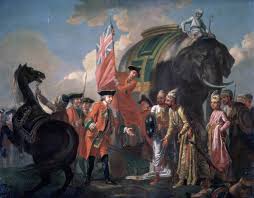
Clive after the Battle of Buxar

Henry Truro Bray wrote in his book, The Evolution of a Life, that his great grandfather was a Bengali prince who was kidnapped by the British while bathing. Henry himself was quite a character, a renegade Methodist minister who gave up his religious career to write books on physics and spiritualism around the turn of the century. In one of his books he describes how a former Egyptian, now running for office on Jupiter, had visited him to ask for a letter of recommendation.

However romanticized HTB’s family stories have checked out at every turn. And the baptismal record in the Church of England at Truro for a “Peter Truro” in 1777 confirms that Peter is an adult (he marries two years later) and that he is a foreigner (literally “a black”). Peter’s family of mariners lived in Flushing and ran The Seven Stars, an inn which is still standing today (albeit, it has new walls after burning down at the turn of the 20th century).

———–

Scrapbook

* Will of Catherine Richards Truro (Original in PDF here)

* Transcript of Will of William
Truro
(Original in PDF here)

* Notes on Mary Lavinia Howe Truro Bray
—- "Forty Miles to Falmouth," Mary Lavinia Bray, Munsley’s, 1907


Apr 262008
 

Last Will and Testament 1817 ( Original Here )

___________________
This is the last will and testament of Mrs. Catherine Truro of Flushing in the parish of Mylor in the County of Cornwall widow which I make publish and declare in manner and form following that is to say all my just debts funeral and testamentary expenses to be in the first place duly paid and satisfied and I charge all and singular in personal state and effects with the payment thereof I give over and bequeath unto my brother Joseph Richards of Flushing aforesaid Mason Thomas Brout of the same place custom house office and Thomas Luke of the same place Mason all that my household furniture dwelling house and premises situated in Flushing aforesaid in my own occupation and my tenants or lodgers which I hold under a lease determinable on the lives of myself and aforesaid who are hereinafter named to hold the same with the apartments unto the said Joseph Richards, Thomas Brout and Thomas Luke their executors, administrators and arbutus for all such term estates and interest shall have accrued at the time of my decease upon trust in the first place by and out of my residuary personal state hereinafter mentioned or a competent part thereof to raise so much money as shall be necessary and sufficient for renewing the lease of the said premises and substituting the life of my Granddaughter Lavinia Howe Truro instead of me and for defraying the first and other expenses attending such renewal and in the next place in trust that the aforesaid trustees do and shall review and take the rents and profits of the said premises as the same shall become out and after deducting and paying there out the annual rent taxes and necessary repairs of the same premises do and shall pay and apply one month or half part of the net rents and proceeds unto my son William Truro and his arbutus during his natural life and the other month remaining or half part subject to worthwhile charities with the payment of the sum of two pounds when and so soon as my said granddaughter Lavinia Howe Truro shall attain the age of fourteen years with said sum of ten (100?) pounds I direct my said trustees to revise and retain accordingly and to apply together with other monies after mentioned for or towards putting out my said Granddaughter approaching or otherwise advancing her life provided for that if any time after my decease in the judgment of my said trustees or any two of them or the survivors or the survivor of them his executors or administrators my said granddaughter shall be unkindly or improperly treated by her father or mother in law then I will and direct my said trustees to pay and apply for the money or half part of the said rents and profits heretofore given to my said son William unto and for the sale use and benefit of the said Lavinia Howe Truro and so as the said William Truro shall not interfere through nor the same be in any as subject to his debts rental or engagements and if practicable I desire my said trustees in such rare happening to remove the said Lavinia Howe Truro from her said father or mother in law to such other residence as they have in their discretions shall so fitting and from the and immediately after the decease of other of my said sons and devise out monthly or equal half part of the said dwelling house and premises with the apartments (?) unto the said Lavinia Howe Truro her executors, administrators and arbutus and after the decease of any of the other of my said sons, Father and devise the other or remaining half part thereof unto the said Lavinia How Truro her executors administers and arbutus also I give and bequeath unto the said Joseph Richards, Thomas Brout and Thomas Luke the sum of ten (100) pounds now in the hands of the said Thomas Luke and also Luke and also such sums as shall become payable upon my decease from the club of which I am a member in trust to put and place forth the same at interest upon good security and pay the interest thereof unto the said son William Truro and his arbutus until my said granddaughter Lavinia Howe Truro shall attain the age of fourteen years and when and so soon as she shall attain her said age of fourteen years the in trust to apply the same or combination thereof for her advancement in life and so much of the residual thereof from time to time as they in their discretion shall see fit for the necessary purposes of the said Lavinia Howe Truro and if any remain unapplied as aforesaid in trust to pay the same unto the said Lavinia Howe Truro on her attaining her age of twenty one years or being married which shall first happen also I give and bequeath unto the said Lavinia Howe Truro all my wearing apparel silver spoons best bed quilt and new large bible toe to be maintained and taken account of my said trustees in the presence of my said son William Truro as soon as reasonably may be after my decease and then to be securely locked up in my two trunks and deposited in care of John Edy Brout (my said son William keeping the keys thereof) until my said granddaughter attain the age of fourteen years when I direct the to be delivered up to her for her own use and benefit provided always that in case the said Lavinia Howe Truro shall happen to die under the age of twenty one years being unmarried then I give and bequeath the **** or dwelling house moneys offers and premises heretofore given and bequeathed to her or for her benefit unto and between my said two sons William Truro and Anthony Truro to share and share alike as tenants in common and to their respective executors, administrators and arbutus and all the test residue and remainder of my goods chattels monies and securities for monies *** household furniture personal estate and efforts whatsoever and whosesoever not heretofore or otherwise disposed of after and subject to the payment represent of my just debts funeral and testamentary expenditure I give and bequeath the same and every part thereof unto my said sons William Truro and Anthony Truro to be equally divided between them share and share alike and to their respective executors administrators and arbutus and it is my wish and will that my said trustees shall not be answerable or accountable one for the other but each for himself and his own deeds and defaults only for any loss happening to the said trust premises except by their own default and that they may deduct and retain all such reasonable costs and charges as the they shall sustain in the execution of the trusts hereby in them reposted and lastly and lastly I constitute and appoint the said Joseph Richards Thomas Brout and Thomas Luke executors of this will and thereby revoking all forms and other wills testamentary dispositions by me before made to declare this only to be my true last will and testament in witness whereof I have hereinto set my hand and seal this twenty first day of June one thousand eight hundred and seventeen.

The mark of Catherine Truro … the writing within routinely was duly signed sealed published and *** by the within named Catherine Truro as and for her last will and testament in the presence of us who in her presence and at her request in the presence of each other have hereinto subscribed our names as witnesses, Robert Rimell Sol. Falmouth, Edgecombe Rimell

On the 7th of March 1822 administration with the will disposed of the Goods, Chattels and Credits of Catherine Truro late of Flushing in the parish of Mylor in the county of Cornwall widow deceased was granted to Willam Truro one of the natural and lawful children and on e of the residuary signatures named in the will of the said deceased having been first sworn by commission duly to administer Joseph Richards Thomas Brout and Thomas Luke the executors named in the will having first renounced the probate and execution of the said will.

Apr 262008
 

Written by Mary Lavinia Bray
Munsey`s Magazine, 1907

Written by her granddaughter Mary Lavinia Bray, the following story is based on the true story as related by M. Lavinia Truro Bray. It is not hard to infer that Letitia is Lavinia Truro Bray, Richard Brent is her husband Richard Bray and the cruel Sir. Hargrave is William Truro. St. D is most likely St. Day. I owe my copy of the story to Betty Bray Burry and to the Descendents of Mary Lavinia Bray who alerted me to its existance.

***

Seventy years ago, a beautiful English girl stood hesitating at the entrance of a shop in St. D. The rain, which had begun in large, splashing drops, was now falling steadily, and her carriage, according to her own explicit instructions, was awaiting her at the confectioner’s, some distance away. She must be home early, in time for afternoon tea; but how would it be possible to reach the other shop without ruining her beautiful gown?

As she gazed upward in the gray, slanting rain, distress and appeal upon her face, a young man, springing apparently from nowhere, stood, hat in hand, at her side.

“May I offer you my umbrella?” he asked.

She started, blushing deeply with an acute embarrassment of modesty, which her American granddaughters have never known.

The stranger’s tone was most respectful, his manner entirely deferential; the situation was urgent; and, besides he was a very fine man – not fine as to his clothes, which were plain, almost shabby – but in person, being well-built, straight-nosed, and clear-eyed, with skin that showed as fair as a girl’s where it had not been bronzed by exposure to the sun.

Letitia fluttered in shy gratitude. “Thank you sir! But I – Could I – how could I return the umbrella?”

“Pray keep it,” he answered. “I am only in town for this afternoon, and it is not worth sending into the country.”

“Oh!” Exclaimed Letitia. “I could not think of accepting a courtesy which could cause you such inconvenience.”

She blushed more deeply, and he stammered apologetic entreaties. “If you might escort me to my carriage,” she suggested timidly.

“If I might have that honor,” he plied. And the next moments her gay skirts daintily lifted, she was setting forth under his umbrella.

The boldness of her act made Letitia dumb. It was quite a fright at herself that she hurried toward the confectioner’s shop; but when, with grave courtesy, he assisted her into the conveyance, she raised brilliant eyes toward his.

“Thank you,” she said. “I shall not forget your kindness.”

All her life she could remember his look as he answered, “I shall never forget the pleasure.” Her one furtive, backward glance thought the small window showed him watching the carriage, bareheaded, in the rain.

A few days later, as Miss Letitia with her maid was driving through St. D., he passed them on the street, bowing deeply in response to Letitia’s tiny salutation. It chanced that another day they met in the very shop whose entrance she had waited that rainy afternoon, and it was but natural that a few words of greeting should be exchanged. He did not tell her that he had come back to town, to the peril of affairs at home, haunting the streets and shops in the hope of another glimpse of her, and recognition. Nor did she acquaint him of the fact that daily she had driven through St. D., demure, but with flushing cheeks and eager eyes.

II

This was the beginning. Within a year these two had sounded for each other almost every note in the song of youthful love, cruel pain and ecstasy.

It was beyond expectation that father would consider for a moment the claims of a farmer – and port young farmer – as a suitor for her hand; they had both tried to be obedient, but the rare love, which had told them from the very first that they were for each other, would not be denied. One glorious, starry night they met for a farewell, and the next day found Letitia, daughter of Sir. Robert Hargrave, wife to Richard Brent.

They were wonderfully happy, so happy that when her fine dresses wore out, without regret Letitia replaced them with the cheapest stiff, fashioned into garments by her own hands. They never knew what it was like to have, as surplus of anything, for the farm was very small, yielding only enough for a family’s bare support, and that through unremitting toil. Richard did two men’s work upon his land, going forth at daybreak and stopping scarcely before sunset. If he had not been magnificent of physique and strengthened by buoyant love, his task would have seemed impossible.

He did other work, too – not man’s work; for his bride had never been taught the homely tasks of a woman in her present station, and try as she might and did, such a matter as even simplest cooking remained a problem to her. If she baked a pudding, it was likely to turn out watery at the top and burned at the bottom; she never learned proper savoring; and to make bread was impossible. So, many a laugh they had together while he kneaded dough to be set before even her. There was never any rough work that he let his beloved do, and Letitia’s hands remained almost as white and soft as in her girlhood days.

One accomplishment she had, fitted for a poor man’s wife, and that was the skilled use of the needle. Many children came to them, handsome, sturdy, little ones, and their garments were marvels of sewing – clean, whit e materials embroidered elaborately or trimmed with lace of their mother’s making. By their clothing and good manners, hers might have been taken for children of some fine lady.

Years went by, Every additional mouth to feed brought increased responsibility and care to Richard Brent but so great was his joy in wife and little ones that for each opportunity of doing for them, being a devout man, he thanked God.

It happened one fine day in May while Letitia was sitting among the roses and flowering shrubbery before their cottage, watching her rosy-cheeked children tumbling together in play, that an imposing vehicle came to a stop before the place and a lady alighted.

“What a charming spot!” Letitia heard the newcomer exclaim, as she stepped gracefully through the gap in the hedge of briar-roses, which served for a gateway and walked down the path.

Letitia rose to receive her, clasping her youngest child to her breast.

“My good woman,” the visitor began graciously, can you oblige me with a glass –: she cried out, “Letitia!”

The young mother would have flung herself upon her sister’s bosom, but the manifest pride of the latter, who, like the rest of the family, had so utterly cut off interest in and connection with the girl at her marriage as not even to inquire the exact place of her abode, froze Letitia’s impulse as quickly as it had spring.

The sister glanced about the place and laughed. Letitia flushed and was silent.

“So this is where you live!” she exclaimed. “Charming, rustic place! What a picture you make with the children, to be sure! All yours, I presume?”

Letitia bowed, her eyes filling suddenly with tears, which she would not allow to fall.

“Well, this is even lower than we had supposed you were.” She glanced through the open door of the cottage. “To think! Not even a carpet on the floor; and altogether I fancy you have no more than four rooms. And such a gown – when you used to have such different things! My poor sister!” she said. “But I suppose it is foolish to expend pity upon you as you are undoubtedly very happy.”

“I am very happy, thank you,” said Letitia firmly, and speaking to one of the little ones who was clinging in her skirts and peeking shyly at the elegant figure of the visitor: “Go, my dear, and get a cup of water for the lady.”

The child obeyed. The lady sipped the water, murmured thanks, and in a moment was in her equipage rolling in stately fashion down the road.

As the carriage passed out of sight, Letitia sank upon the wooden bench beneath the rose-bushes, heedless of her children’s eager questioning, a pang in her heart that had never been felt before.

III

As he came toward their home that evening, Richard missed the usual caroling of his wife’s voice. There was an unusual silence, too, at the evening meal, badly cooked as it generally was, but set forth upon a snowy table; yet he forbore to ask any questions until the little ones, with evening hymn and prayer, had been put to bed. Then he led her out to the bench in the garden.

It was a beautiful night, sweet with the scent of breathing flowers, starlit and still, except for the distant singing of a night-bird. It was sweet to her, too, to have his arm around her head upon his shoulder; but unrest was stirring in her bosom, and she did not relax to the tenderness of protecting love.

“What has gone wrong, Letitia?” he inquired gently. “Why is my dear one troubled?”

“Nothing,” she answered with a deep-drawn sigh.

“But something is the matter,” he persisted “Tell me what is on your mind – whatever it may be.”

He pressed her to his side, and was chilled to the very heart by a faint resistance. He sat bolt upright, fear in his eyes but mastery in his voice.

“Speak to me Letitia,” he commanded.

Then in a miserable little voice, she pored out to him the foolish disturbance of her soul.

“My sister came today. Think of it! My sister! She did not me until she had come almost to the very door, asking for a glass of water. I do not know how she chanced to driving this way. And, Richard, she exclaimed upon my poverty and scorned my dress and looked coldly upon my children. She is married to a rich man. I do not care for myself; but hers will have everything that parents can desire to give to their children and what will become of mine? They will have a pittance to live upon, a bare existence in this wretched little cottage, sneered by their own cousins. I almost wish that they had never been born!”

Her husband was shocked to the uttermost, stunned.

“Letitia!”

“Oh yes!” she exclaimed with a burst of tears. “It does not seem dreadful to you, for this is what you were brought up to; but I have been different. I would have my children such as we were at home, growing up to be ladies and gentlemen, not scrambling about bare floors and learning to dig in the field. When I was nine years of age I had lessons in music. What can I teach little Elizabeth? In a hundred years we could not buy a harp or a pianoforte.”

“I am not complaining of my lot,” she continued. “I choose and am satisfied; but seeing my sister’s condition today roused me from my blindness. For myself I do not care; but it is a lasting shame to me that I have brought children into such poverty.”

That which he had dreaded in the first years of their marriage had now come, long after he had ceased to give it thought as a possibility. He spoke very slowly, painfully.

“We, perhaps, do not need to be so poor. I could do better away from here. But I loved this land, and would not give thought to going away. For two hundred years we have tilled it, father and son. I thought that you loved it, too.”

His voice failed, but she was silent.

This bench my great-grandfather made. This cottage was built by his great-grandfather. Every blade of grass in the ground is dear to me, being mine. I had thought you were contented here, even though we have so little.”

“It is enough for two,” she said cruelly. “But I am weary of struggling for so many.”

IV

He was thinking rapidly, striving to be a man in the face of this bitter blow! “I have been the happiest man in the world, ” he said to himself, for eleven years. God has been good to me. I will not complain to Him now.”

“If you could only make money,” she said: “If you could only do something besides cultivating this miserable bit of land, we might have a better house and give our children education and position that would fit them for anything – Why! I have not felt between my fingers a piece of silk in eleven years.”

She was crying quite tempestuously now, and he did not seek to comfort her. He leaned back on the seat and gazed at the tranquil stars.

“I have been a fool,” he said, to think that I could keep you contented here. As to the children, it is enough for any child to have an honest father and a good mother, to be brought up in healthful simplicity in the clean country and in the righteous fear of God. Such a child who cannot make his way in the world is none of mine. But since you long for silken dresses” – his voice, which had become hard, grew suddenly very kind – and also for a harp, and perhaps other fine things – these things you shall have. I am man enough to get them for you.”

“But – you will have to go away, Richard!” her voice faltered.

He had an instant longing that she would not let him go, but answered: “How can I make money here?”

She hesitated, then said, with a consciousness that her words were partly false: “It is for the children. If it were not for their sake I would not let you go.”

He laughed, saying nothing, and she was stung into further defense.

“My sister!” she cried childishly. “I will not have laugh at me and mine.”

“She shall laugh for another reason,” he replied almost roughly. “The time will come – and within a few years – when your finery and your children shall outshine hers. My purpose in life has been love. It shall be money.”

“Come into the house, Letitia,” he ended abruptly. “It is getting late.”

Within a week necessary preparations had been made, and Richard was ready to leave. At the last moment she had it in her heart to bid him to stay, but visions of luxury flitting through her brain, and a new dignity in his manner, made it easier to let him go.

The days were maddeningly long and empty until a letter at the end of the week brought relief. His uncle had gladly received him; he was doing well; at the end of the month he would send money and put money in the bank. It was a matter for great regret that he had not taken the opportunity when they were first married. In eleven years they might have had quite a comfortable fortune.

Eleven years! Letitia put the letter down with a sickening feeling. If it had been eleven years ago, that might have been fine; but if in eleven years to come – No, not even then; these years past she could not wish had been spent anywhere else; nowhere else could they have had such perfection of happiness.

The children were beginning to fret for father. What had become of the kind parent who played with them as no one else ever could, whose stern voice in correction struck the small soul with awe, and whose laughter betokened such merriment and fun? They plied their mother with questions. Individually, and in little groups they cried. Sometimes they made her frantic, and she spoke to them in sharp tones that had been foreign to their ears, at which they cried more pathetically.

The letter came, cheerful and promising. The children questioned less, but grew wistful, stopping often in the midst of play to climb a hillock overlooking the road and watch for the coming of father. Egbert, their precocious one, who even at his tender years loved his studies with his father, silently pined.

More mystification and grief fell upon the children when mother embraced one and all, with fervent kisses bidding them all to be good and obey Elizabeth, the eldest, and Mrs. Kenton, would come in to look after them until she returned. And then, clad in her “second best,” a bag thrown over her arm and an umbrella in hand, she walked away and soon dwindled into a speck on the same road that had swallowed father.

V

It was about forty miles to Falmouth. Only a few shillings had been left at home when her husband went away, and the end of the month had not quite come; but what were forty miles when love waited at the end of the journey?

All day Letitia walked. The sunshine was hot, but trees cast cool shadows over most of the way and she made no stop of more than a dew minutes until nightfall when, as she planned, she came to a wayside inn. In the morning her feet were still weary and her limbs somewhat stiffened, but she was used to long walking and climbing over the countryside, and after a simple breakfast resumed her travel eager-hearted.

When the sun was setting on the second day, steadfast but weary, Letitia entered Falmouth, inquired the way to a certain address, and thither benter her steps, not so elastic as they had been the day before.

“What a mean little place! She exclaimed to herself, as the lodging house to which she had been directed came into view; and the conviction that he was living cheaply in order to save money for her gave her a bitter twinge. What a difference between this and the clean cottage with the acres of green grass and fertile meadow, which she had called wretched!

As they went to summon Richard Brent, she hastily brushed the dust off her shoes, wiped her face with a kerchief whose daintiness did not correspond with the plainness – almost coarseness – of her dress, and smoothed her hair.

Her husband appeared, speechless with amazement, and led her into his room. Even in her confusion of mind, she noted that it was barren and not over clean.

‘The children are crying for you.” She began bravely, though her eyes shone with tears. “They are breaking my heart with pleading for their father.”

He looked at her with a strange sternness and her courage almost failed.

“It is not only the children, Richard,’ she said. “I cannot live apart from you.”

“I am doing five times as well as before,” he said slowly. “Some day we shall all be rich in Falmouth.”

“I would not live in Falmouth,’ she exclaimed passionately. I love the little farm as you are living here, and we cannot be separated while you are preparing a place for us. Richard, we will stay on the land that has been the home of your people for so many generations!”

He looked away frowning. ‘But the silken dresses,” he said, “and the harp for Elizabeth, and humbling of your sister -”

She quailed utterly at a terrible thought. Had love of money beset her husband to the death of love for her! Could it be? Letitia sank into one chair. Richard lost to her! Could it be? What an awful curse upon her wicked discontent!

He turned toward her, the light of sudden question in his eyes.

“Where did you get the means to come Letitia? I left next to nothing, and” – he seemed bewildered – “surely I have not yet sent money.”

“I had no money,” she faltered, “so I walked.”

He clasped her in his arms, forgetting all the obstinacy of pride and wounded love.

“Letitia, God bless you! Have you wanted me at home?”

“Wanted you?” she raised her head, no longer ashamed to let him see the flowing tears. Wanted you, my husband? All I care for in the world is that you shall come home.”

They rode back to St. D, and it was a group of happy, shouting children who discovered them like a troop of hungry little wild animals.

***