
In 1806, in Mary Tavy, Devon, Joseph Burn was born out of wedlock–a fact that undoubtedly made his life difficult. The certificate for his second marriage, for example, clearly states “base born” for both him and his wife. It also threatens to make him a genealogical dead-end.
However, It has been possible to piece together a plausible theory about his origins, even if I have not been able to prove it to date.
First, the known facts
- Joseph Burn was baptized by Elizabeth Burn in Oct 1806.
- His 1st Born son is John Lloyd Burn.
- His second born son is Josiah Princemeet Burn.
Who was his Mother?
While his mother was Elizabeth Burn; she was not the only one of that name in Mary Tavy. There were at least two Elizabeth Burns of the right age born in Mary Tavy around the right time. Nevertheless, because Tammy Burn Skelly (the sister of Elizabeth by father Roger Burn) signed Joseph’s death certificate, was a close neighbor and seemed to maintain otherwise close ties to the family, it seems likely that she was Joseph’s aunt and my own database makes this connection.
Who was Joseph Burn’s Father?
Joseph’s potential father might seem like a real dead-end. No record of a bastardy suit has been unearthed (such a record was very helpful for unearthing a hitherto unknown child of his grandson, John Lloyd Burn, for example.) However, it is possible to dream a rather far-out theory.
This all started with an autosomal DNA match to my mother in an Ancestry DNA test. The match is 32 centimorgans–relatively significant. Ancestry reports this is a predicted relationship of 4th to 6th Cousin. For comparison, some of my mom’s cousins who are direct descendants of Joseph Burn, and for whom I can count on well-confirmed paths match at 32cms or below. I knew because of shared cousin matches that this match was on the line of Joseph Burn. This is useful because I could focus on Joseph himself, the Burn lines and, ultimately, as none of those lines coincided with anything in this person’s tree.
Yet, that was a challenge even narrowed down to the Burn family because nothing, no nothing looked familiar. The first issue is that this tree had little in common with mine geographically. There were almost no families in the Southwest of England (from whence originate the Burns) in this person’s trees. Since along some lines of the Burn family it is said that Joseph Burn “came from” Scotland, I focused on the Northern England and Scotland lines of this family. But I came up cold. The tree also has a little corner in Cornwall. Excitement was short-lived; nothing connected. OK, that took me a long time.
What I know about Joseph Hyde
The naming of Joseph’s children is a big clue. Joseph names his first two sons, John Lloyd Burn and Josiah Princemeet and his grandson was named Josiah Prince Frederick Burn. As it is tradition to name the first born son after the father’s father, it is possible that Joseph’s father was a “John Lloyd.” This name is also repeated for several generations. At one point, I found a local John Lloyd, petty gentry, within the proximity of Mary Tavy. But after collecting wills and all the records around the life of this fellow, I concluded that a connection, at least to the father of Joseph Burn for whom I was searching was highly unlikely.
That took me back to basics. Elizabeth Burn named her son “Joseph,” a name that was neither her father’s nor any of her brothers’. Soooooo, in maybe bad form, let’s start the inquiry by raising the possibility that the base born boy was named after a father, also named “Joseph.” That led me to a Joseph Hyde in the online tree, the father of a Sarah Hyde who are on the tree’s direct line. By the way, I am avoiding giving the name of the tree’s contributor.
This Joseph Hyde lived in the county of Dorset, where I have done relatively little research in the past in an a small farming village called Shipton Gorge. I even had a moment of realizing that Dorset is the next county over from Somerset and by sea not far from Plymouth. Let’s look at what is knowable about this Joseph Hyde.
Joseph Hyde senior was born in Burton Bradstock in 1773 to a family with property and history in Shipton Gorge. He had four children, the twins Catherine and Sarah (1766), Betty (1769) and Joseph (1772). His will, written probated between his death in 1790 and 1807 leaves bequests to his daughters Catherine and Sarah and his son Joseph Jr who is under 21 years old. Apparently his daughter Betty has died before this since she is not mentioned.
20 Jan, Under 100 lbs, Abstract of will of Joseph Hide, the elder, yeoman
Joseph Hide of Shipton Gorge, executor
My son of Joseph shall attain the age of 21 years
Sarah Hide, daughter
Catherine Stone, daughter
I give and bequeath unto my nephew Joseph Hide in trust for my son Joseph Hide all the residue and remainder of my estate and effects whatsoever and wheresoever. (Accessed Dorset Archives Online)
The nephew in the will, I believe is, the son of Joseph’s brother Edward Hide. This is important because in the next probate record we find Joseph Jr., a bachelor, has apparently passed away by 1806, leaving his cousin Joseph (son of Edward) with his property.
1806 Shipton Gorge
18 Oct, Under 300 lbs, Joseph Hide, bachelor. Joseph Hide of Shipton Gorge, the lawful cousin and next of kin, administrator. (Accessed Dorset Archives online)
Thus, Joseph Hyde Jr died young several months before Joseph Burn was baptized in Mary Tavy, Devon. Joseph Burn was baptized the 21st of September 1806, with a little math we can imagine that he was conceived around 21 December 1805. Whoever his father is would have had to be in the proximity around that date.
What opportunity would Elizabeth of Mary Tavy have to meet Joseph Hyde?
Mary Tavy is a small mining village on the western edge of Dartmoor about 18 miles from the city of Plymouth to the south. Plymouth was a major shipping and navy port with industry that revolved around both shipping and war activities. I can imagine that for Elizabeth Burn it was the big cosmopolitan city. It is hard to know exactly, Tavistock, was much closer, but I imagine that in 1806 Plymouth was quite a draw. I know I found a record that suggests that she may have lived in Plymouth in 1805. I will have to locate it. If Elizabeth were in Plymouth, of course, she could have met people from across England and the world. She could have met a young Dorset-born sailor named Joseph Hyde.
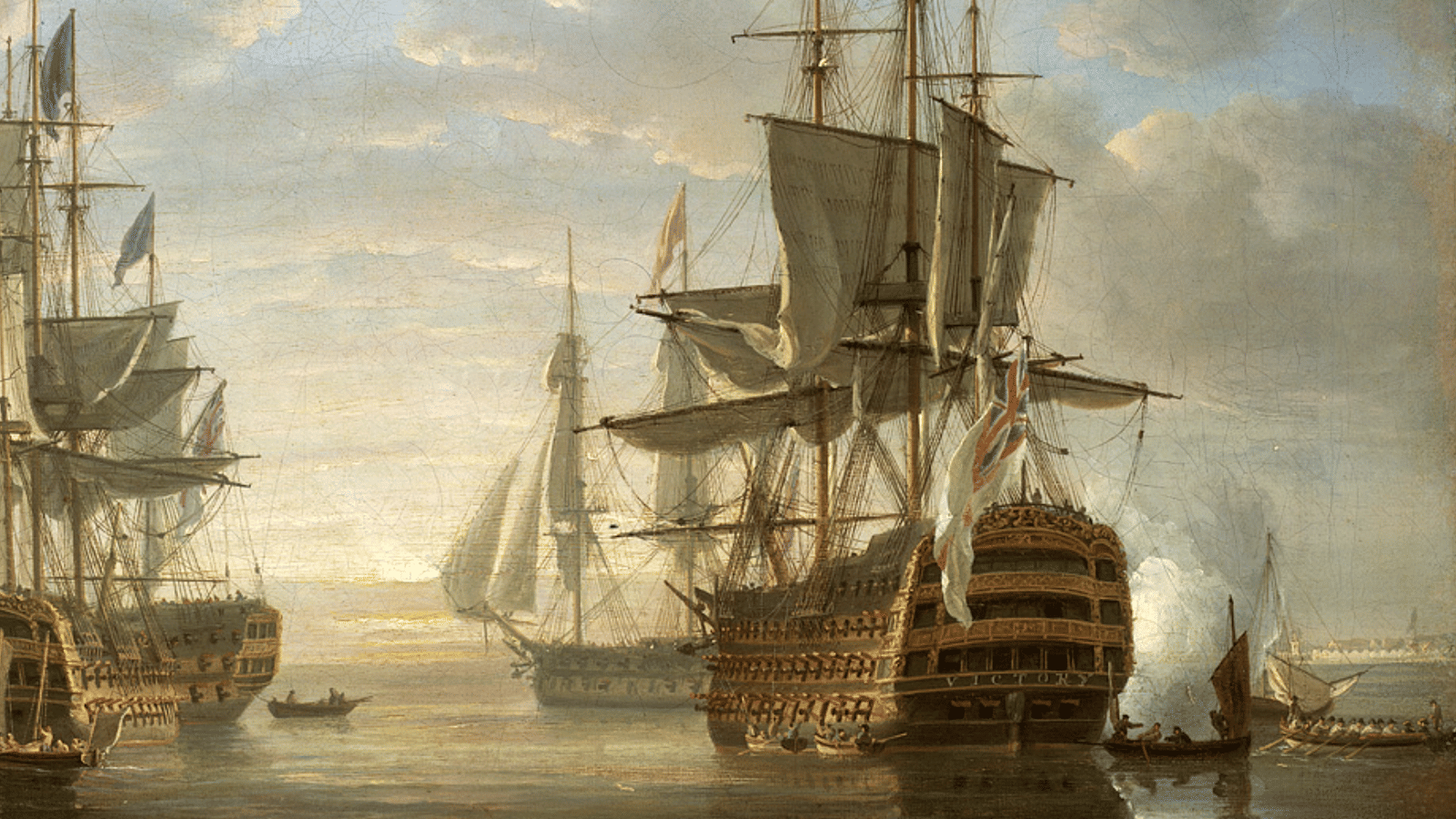
To take this further in 1805, there was a war raging in Europe. The British had just turned back Napoleon at the Battle of Trafalgar in October 1805. The battle involved around 300 British ships and the famous Horatio Nelson lost his life aboard the HMS Victory. Many other marines were killed or wounded in the battle as well. They were brought to navy hospitals in Britain. One of these was in Plymouth, called the Royal Naval Hospital (Stonehouse). Among the hospital ships in the Battle of Trafalgar was the HMS Prince Frederick (there is probably a full list somewhere, but a quick search shows that this ship was, in fact quite active in this period of time).
We also know that the HMS Prince Frederick was in Plymouth Dock from 1803 to 1815:
17 Apr 1803 was commissioned at Plymouth Friday last, as a receiving and convalescent ship for recovering convalescent seamen and marines sent from the Royal Naval Hospital, [Stonehouse ?], previous to their being put on board their respective ships.
May 1805 Plymouth
Navy Office 19 Jul 1816 Lying at Plymouth ; offered for sale for 31 Jul 1816.
28 Aug 1816 lying at Plymouth ; offered for sale (source: https://sites.rootsweb.com/~pbtyc/18-1900/P/03641.html )
In a war, hospitals become overwhelmed and they tend to engage young woman as employees or volunteers to help care for the wounded.
I suspect that 17-year old Elizabeth Burn might have been among the volunteers at the Royal Naval Hospital. Perhaps she travelled the 19 miles from Mary Tavy and lived with a family member or friend (or stayed in a boarding house). This hypothetical can place Elizabeth in Plymouth from October 1805 to March 1806. Now she would have had the reason to meet quite a few sailors, wounded or not, from the British fleet. I am thinking that, perhaps, one 26-year old Joseph Hyde had become a sailor at some point. Perhaps he was at the Battle of Trafalgar and was wounded. His time in Plymouth would have been for recovery. One possibility is that he succumbed and died in Plymouth by end-of-March. In this scenario he could not have been too wounded for a tryst. Of course, he could have recovered and gone back out to the war, dying shortly thereafter. While I have found no proof of a Joseph Hyde among them, I know that the Royal Navy Hospital in Plymouth had many wounded marines as evidenced by the wills below. There are lists at the UK Archives of the patients and staff; unfortunately, they have not yet been scanned but accessing them might be a next step.
1806 Wills left at the Royal Naval Hospital in Plymouth. John Blade, of the HMS Prince Frederick left his will in March 1806 to his family in Norfolk and Felix O’Neal, of the HMS Prince Frederick left his will in March 1806 to his family in Sligo, Ireland.
For a long time, I thought that the names “Princemeet” and “Prince Frederick” referred to perhaps an event where someone in the family, perhaps Elizabeth Burn, met with Prince Frederick, Duke of York and Albany (1763–1827), who was a British field marshal and second son of King George III. Princemeet would thus commemorate meeting the prince an Prince Frederick would be in honor of the man. Perusing the life of this historical figure, however, led to nothing. Except, it did make sense that the father of Joseph Burn was likely in the navy as the simplest way in which the prince could have been met.
Whenever I was hunting for information on Prince Frederick, I would see but ignore information on the ships–there were at least three that were named after this man. But it could make sense that Elizabeth met a sailor, say Joseph Hide, while his ship, say the HMS Prince Frederick, was in Plymouth dock. Looking through the history of these ships and searching the UK National Archives, I found that the HMS Prince Frederick could have been at Plymouth Dock in the end of 1805. At least, the following records might place it there between August 1805 and March of 1806:
- Marriage of Benjamin Coombs, seaman of the Prince Frederick in Hamoze, unmarried and Elizabeth Grant of East Stonehouse, widow, 14th August 1805 https://devon-cat.swheritage.org.uk/records/DEX/7/b/1/1805/362
- Marriage of James Taylor, carpenter of HMS Prince Frederick, widower to Esther Stevenson of Stoke Damerel, spinster, 19th March 1806 https://devon-cat.swheritage.org.uk/records/DEX/7/b/1/1806/129
I imagine Elizabeth working at the hospital under the supervision of a John Lloyd. I know he was a “clerk” but beyond that it is just my desire to explain every loose end.
For any of this to make sense, Joseph Hyde would have had to be in the navy in this period. I have found no proof of this. On the other hand, the British navy was very active in 1806 with significant casualities (This Wikipedia wiki documents some of the Atlantic campaign of 1806). It is quite possible that someone like a young Joseph Hide never returned home from a battle at sea.
Back to the DNA
So far this is a just a story, with scant records and certainly no proof. Starting from an autosomal match, eliminating much of the possibilities on that line and pursuing one of two Josephs (the other was far away and of much higher class), and then seeing if I could tell a story that would fit within the very odd naming clues, that is where I arrived.
Armed with this story, I began to fill out the family of Joseph Hyde of Shipton Gorge and his wife Elizabeth Brown. I must say, that there are many links low confidence here and many Joseph Hydes! But on the whole, using wills and parish registers, I think it is a reasonable telling going back three to four generations.
When this task was complete, I returned to the cousin matches on Ancestry and began to look in the unmatched Burn family matches of my mom for missing links. Here I was quite pleased, I found 12 matches that suggested distant cousins through Joseph Hyde (trying to scour each to make sure there were no other matches. Of course, no tree is complete but I found that a combination of two factors–a person was a shared match with my known Burn cousins, and their tree included this small region of Dorset, gaive me some confidence). The centimorgans range from 9 to 32. Out of the twelve matches, three link to the Brown family and eight link to the Hyde family of Burton Bradstock/Shipton Gorge. That led me to a Joseph Hyde in the online tree, the father of a Sarah Hyde who are on the tree’s direct line. By the way, I am avoiding giving the name of the tree’s contributor.
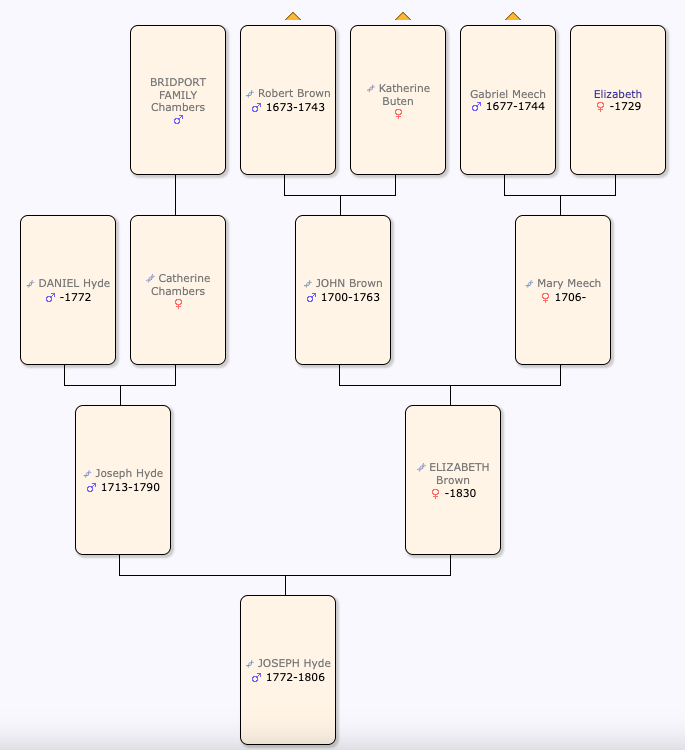
This DNA proof has two related issues. The matches tend to be at the top of or slightly above Ancestry’s predicted range. For example, my two matches of 32 cms have a predicted range of 4th-6th cousins (meaning my mom should be a cousin of the test taker within that range). But in one case she is a 7th cousin and then other she is in the range as a 5th cousin. And the second issue is that I have not been able to recreate the original Ancestry tree that led me to Joseph Hyde to begin with to my satisfaction.
Conclusion
All of this leads me to a conclusion that Joseph Hyde is a good bet to be the father of Joseph Burn…if he was in the navy…if Elizabeth Burn was in Plymouth in 1805…if he died, perhaps never knowing that he had a son born in Devon.