
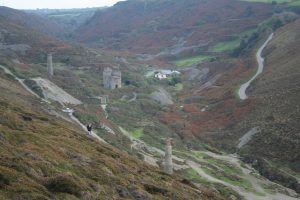
The surname Bray, perhaps from a word that means hill and perhaps from French origins, starts for me with Robert Braye who was born before 1483. Pieced together from string and duck tape, the line encompasses many of the Cornish Brays. The links should be taken with the caution, sources reviewed and you may come to different conclusions.
In the next generation, Thomas Bray, son of Richard, married Bridget Hodge in 1810 in St. Agnes and was the father of Richard Bray who married Lavinia Howe Truro (died in 1900 in Negaunee, Michigan). Of this Richard, his father, Henry writes, “with the consent of my dear father, whose health was gradually getting worse, I determined to go to America and join my sister Kate, at Hilltown, Michigan, in the hope of doing more for him whom I loved with my whole soul. So great was my love for my father that, when absent from him in person, his ghost, or shadow, seemed to follow me.”
Elizabeth Ann Bray, daughter of Richard, married Joseph Piper in Cornwall around 1860. He was a miner and apparently took his family across Cornwall looking for work. Sometime after Joseph died of “pneumonia” on April 6, 1877, Elizabeth left Cornwall and traveled with her family to the United States. Her siblings Mary Jane Rapson, Catherine Slockett, Priscilla Paynter, Henry Truro Bray, Joseph Bray and Richard George Bray were already in the United States.
Read Henry’s description of his heritage from his book the Evolution of a Life (below).
At least one sister, Catherine Richards Bray Slockett was running a boardinghouse with her husband Henry Slockett in Calumet, Michigan. By November 1879, we know that Elizabeth had arrived in Leadville, Colorado with her three living children. An article in Leadville Colorado’s Herald Democrat reports that Elizabeth died in January 1880, four months after she arrived to run a boarding house on Carbonate Hill. Her daughter Mary Jane Piper married John Lloyd Burn jr. shortly after her death. Another daughter, Bessie Piper, may have lived for sometime with her Uncle Henry Truro Bray in Greeley, Colorado where he was an episcopal minister for a few years. Henry also adopted his niece Leila Piper (who became Charlotte Bray).
Of the earlier generation of Bray’s, definitive proof is difficult. The impressive size of the family coupled with the repetition of family names: Richard, William and Thomas makes certainty difficult. As a family of largely miners, they did not leave many wills. One illustrious Bray, “Billy Bray” (William Trewartha Bray), is a famous Methodist minister in Cornwall (seems likely that he was a role model for Henry Truro Bray). The information collected here is most certainly riddled with mistakes and missed connections. Having jumped too many fences already to get to this state of supposition, the family has swelled beyond my own lines. The tale now begins with Robert Braye and Elizabeth Branscombe in the early 16th century in the village of Lezant (the far east of Cornwall on the border of Devon). I have attempted to note the most egregious jumps in this story by capitalizing names where the child, spouse or parent are insufficiently proven.
______________
Scrapbook
* Preface to Evolution of a Life by Henry Truro Bray
* More about Thomas Henry Truro Bray
* Notes on Mary Lavinia Howe Truro Bray
—- “Forty Miles to Falmouth,”
Mary Lavinia Bray, Munsley’s, 1907