
Adupree dot com — Surfing the Genetic Pool
This site explores the lives and movements of thousands of families.
Most of my lines hit a brick wall around 1550 when many churches began keeping records.
I have done my utmost to include source records and to indicate where I am making guesses.
Be welcome to explore and let me know where the forks in the path might lead you.
* The yellow background on this site is the work of French, Huguenot silk weavers in London — see DuPree Family. The header is a country road in Caledonia County, Vermont – see McColl and Buchanan Families.
My Latest Musings

My interest is in the Elizabeth Burn who baptized her base born son Joseph Burn in Mary Tavy in 1806. We have long known that she is the mother of our progenitor but I have had some doubts that she is actually the Elizabeth Burn daughter of Roger and Susanna Bromblecombe Burn born in 1789 in Mary Tavy. Records have pointed this direction. The sister of this Elizabeth Burn, for example, is the informant for the death certificate of Joseph Burn. My central doubt has been around names since neither Joseph nor his children would reference either Roger or Susanna in the naming of any of their children– not necessary of course but remarkable nonetheless.
I am pleased to report that Elizabeth is proven as the daughter of Roger. It starts with the record of Elizabeth Burn who married James Unsworth in Plymouth, England in 1813. He is a member of the Royal Artillery. This caught my eye because I think it likely that the father of Joseph Burn met Elizabeth in Plymouth because he was linked to the navy. I am still not sure why this happened but Burn descendants appear to match with Dorset’s Joseph Hyde and the easiest way to make this happen is through the port city of Plymouth because Mary Tavy is just not a place that would have drawn a lot of folk outside of miners. I say more about this in the blog for Joseph Burn and Joseph Hyde.
James Unsworth and Elizabeth Burn have one child Richard James Unsworth born 1814 in Mary Tavy. So Elizabeth seems to have stayed in her home village, while her husband probably continued in the military. He died sometime before 1839 (but likely closer to 1814, since they did not have any more children). At that point, Elizabeth Unsworth, the widow, remarried to James Williams who was the widower of her sister Ann Burn Williams. The marriage record actually identifies her as the daughter of Roger Burn. Since Unsworth is not a local name, this is, as they say, a smoking gun, proving that this Elizabeth is the sister of Ann and Tammy and daughter of Roger.
and we can be pretty certain that she is the mother of Joseph but this is a little more inference. James Williams is found in the 1841 Census almost next door to Joseph Burn in Blackdown with his wife Elizabeth who is 45 and his daughter Ann and son Richard. Elizabeth Williams died in 1845. He then remarries 13 day apart from Joseph Burn’s marriage to his second wife in consecutive entries in the Tavistock register. [...]
Read more...
PG Prince George’s County, Maryland; MC Montgomery County, Maryland; CC Charles County, Maryland; AC Abbeville County, South Carolina
1746 PG William Sierra Norris in will of father (adopted?) William Norris
1758 CC No Norrises in tax list
1770 PG William Sierra Norris in land sale of Sierra’s Love w Elizabeth & Acquila Compton & Eliz Willis
1771 MC William S Norris buys and sells land.
1776 CC William Norris takes oath of Allegiance, serves as private in Continental Army
1783 CC William Norriss in tax list, William Norris Sr
1784 CC William Norris passed claim by Benjamin Maddux to his brother in law Humphrey Posey’s admin.
1784 CC William Norris is a creditor on estate of George Maddox, admin is Benjamin Maddox his brother.
1789 PG William Norris on deposition related to Mattocke’s Folly with Walter Bayne
1790 CC William Norris sued by Wheeler Posey the orphan of Humphrey Posey.
1790 AC Williamn Norris in Abbeville census, also Maddux and Mannings.
1798 AC William Norris is Admin for brother Wilson Norris.
1796 CC Richard Maddox will says one sister is in South Carolina. Admin is Francis Manning
1800 AC William Norris & Wilson Norris in Abbeville census.
1803 AC William Norris will, wits William Sims, Walter Manning, Henry Gaines
1805 AC payments to William Norris & Wilson Norris, Mrs. Norris on estate of Walter Manning,
1815 AC William Norris Jr. exec for Jennet Maddox, widow of Henley Maddox. [...]
Read more...
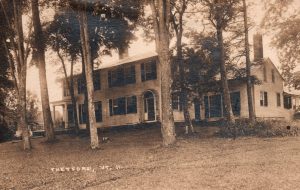
Thetford, Vermont Postcard Circa 1921
DON CARLOS WILMOT’S grandfather, also Don Carlos Wilmot, lived on Archibald’s (a relative) place. There is a hill named after him called “Don Carlos Wilmot Mountain” better known today as “Wilmot Mountain” in Thetford, Va. He was a 49er in the California Gold rush, having gone off to adventure with his cousins. “
He married Lucina A. Graham and lived in the house in which he was born in 1826,” {Gazeteer).
Don Carlos, the son of Joseph & Mary (Freeman) Wilmot, saved enough money to build his house in East Thetford, Vermont in which more than three generations of Wilmots were born. He always lived on the ‘Timothy Willmot’ farm. (From FindAGrave website added by Roscoe Wilmot in 2009)
A LITTLE EXPLORATION OF NAMES
DON CARLOSSo where did the name “Don Carlos come from…Hmmm”1) DON CARLOS, Prince of Spain by John Otway (1676)“…Elizabeth Barry was the mistress of JOHN WILMOT, Earl of Rochester, the poet to whom OTWAY dedicated “Don Carlos”, a heroic tragedy, his first success.”2) A story I heard in Vermont is that there was a particularly bad year when the only sheep that survived had been gifts of DON CARLOS of SPAIN. Many children were thus named in his honor. Vermont records of the time reveal at least seven Don Carloses born between 1789 and 1823: Barrett (1789 Norwich), Mather (1800 Jericho), Hatch (1800 Brookfield), Hunt (1801 Norwich), Wilmot (1811 Thetford), Hawley (1811 Cambridge), Luce (1823 Stowe). None of these have a known relationship to DON CARLOS WILMOT. If we take the locations, they appear to be in two clusters: Norwich(A), Thetford (B) and Jericho (C); AND Jericho (D), Stowe(E), and Cambridge(F) .
View Map
One reads in the Vermont Visitor of 1845, that Don Carlos (infante Carlos 1788-1855) abdicated his thrown in honor of his son. This would mean the first Don Carlos was born about roughly the same time so could not have been named after the Infante, but could have been named after his father, Carlos IV, who ruled until 1808.
Introduction of the Merino probably occurred in 1793. In 1801, a Merino sheep called the “Don Carlos” was bred along the Hudson. Apparently, one William Jarvis of Vermont, US consul to Portugal in 1809/1810 shipped more than 4000 merino sheep to the US and a mania for Merino sheep began to develop (Livestock production and marketing-Google Books).
So, this sheep connection cannot explain everything. It could be that Hunt, Wilmot, Hawley and Luce are actually named after the 1801 sheep came to the US (thus popularizing the junior Don Carlos. But the naming of Barrett before 1793, when the first Merino sheep cam to the US does not fit.
ARABELLA KINGSBURY“Kingsbury” is a family name that followed on the Moor side. Kingsbury Moor (see http://adupree.com/wp/g/getperson.php?personID=I818&tree=adupree ), Arabella’s great aunt (uncle?), is the first I have found to fit the name. But I have found little about his life to show why the name would merit repeating. Arabella’s cousin William Kingsbury Moor (see http://adupree.com/wp/g/getperson.php?personID=I397424&tree=adupree ) is another to hold the name.
JOSEPHINE MONTAGUE???
HERBERT GNo known Herberts in family. G could stand for Graham?
HAVILAND GEORGEThere are Havilands in Danville. Charlotte, for example, married there Joel Sanborn and named her daughter Charlotte Haviland Sanborne. Is there a link to this family of Wilmots?
CHARLES SOUTHWICKIn 1855 (census) a certain Kimball T Howe (b 1828 NH s of Nathaniel & Rachel Coburn) and his wife Levinia/Valina (b 1836 MA)were living in Middlesex county, Massachusetts. Living with them was 18-year old CHARLES SOUTHWICK a bootmaker from Connecticut. Since Don Carlos and Lucy certainly worked in Lowell, Massachusetts, is it possible that this is the namesake of CHARLES SOUTHWICK WILMOT?
It is intriguing that there Kimbell Howe also has a daughter JOSEPHINE (1856) and a son HERBERT (b 1867) and a Lucinda (b 1854). Kimball was a greenhorn crew member about the Triton a whaler bound for the pacific in 1849. What is, if there is any, the relationship to Don Carlos Wilmot and Lucy Graham? [...]
Read more...
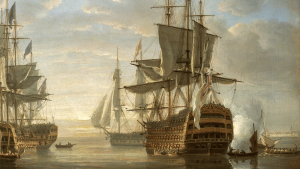
Royal navy ships in the Battle of Trafalgar – 2 Oct 1805
In 1806, in Mary Tavy, Devon, Joseph Burn was born out of wedlock–a fact that undoubtedly made his life difficult. The certificate for his second marriage, for example, clearly states “base born” for both him and his wife. It also threatens to make him a genealogical dead-end.
However, It has been possible to piece together a plausible theory about his origins, even if I have not been able to prove it to date.
First, the known facts
Joseph Burn was baptized by Elizabeth Burn in Oct 1806.
His 1st Born son is John Lloyd Burn.
His second born son is Josiah Princemeet Burn.
Who was his Mother?
While his mother was Elizabeth Burn; she was not the only one of that name in Mary Tavy. There were at least two Elizabeth Burns of the right age born in Mary Tavy around the right time. Nevertheless, because Tammy Burn Skelly (the sister of Elizabeth by father Roger Burn) signed Joseph’s death certificate, was a close neighbor and seemed to maintain otherwise close ties to the family, it seems likely that she was Joseph’s aunt and my own database makes this connection.
Who was Joseph Burn’s Father?
Joseph’s potential father might seem like a real dead-end. No record of a bastardy suit has been unearthed (such a record was very helpful for unearthing a hitherto unknown child of his grandson, John Lloyd Burn, for example.) However, it is possible to dream a rather far-out theory.
This all started with an autosomal DNA match to my mother in an Ancestry DNA test. The match is 32 centimorgans–relatively significant. Ancestry reports this is a predicted relationship of 4th to 6th Cousin. For comparison, some of my mom’s cousins who are direct descendants of Joseph Burn, and for whom I can count on well-confirmed paths match at 32cms or below. I knew because of shared cousin matches that this match was on the line of Joseph Burn. This is useful because I could focus on Joseph himself, the Burn lines and, ultimately, as none of those lines coincided with anything in this person’s tree.
Yet, that was a challenge even narrowed down to the Burn family because nothing, no nothing looked familiar. The first issue is that this tree had little in common with mine geographically. There were almost no families in the Southwest of England (from whence originate the Burns) in this person’s trees. Since along some lines of the Burn family it is said that Joseph Burn “came from” Scotland, I focused on the Northern England and Scotland lines of this family. But I came up cold. The tree also has a little corner in Cornwall. Excitement was short-lived; nothing connected. OK, that took me a long time.
What I know about Joseph Hyde
The naming of Joseph’s children is a big clue. Joseph names his first two sons, John Lloyd Burn and Josiah Princemeet and his grandson was named Josiah Prince Frederick Burn. As it is tradition to name the first born son after the father’s father, it is possible that Joseph’s father was a “John Lloyd.” This name is also repeated for several generations. At one point, I found a local John Lloyd, petty gentry, within the proximity of Mary Tavy. But after collecting wills and all the records around the life of this fellow, I concluded that a connection, at least to the father of Joseph Burn for whom I was searching was highly unlikely.
That took me back to basics. Elizabeth Burn named her son “Joseph,” a name that was neither her father’s nor any of her brothers’. Soooooo, in maybe bad form, let’s start the inquiry by raising the possibility that the base born boy was named after a father, also named “Joseph.” That led me to a Joseph Hyde in the online tree, the father of a Sarah Hyde who are on the tree’s direct line. By the way, I am avoiding giving the name of the tree’s contributor.
This Joseph Hyde lived in the county of Dorset, where I have done relatively little research in the past in an a small farming village called Shipton Gorge. I even had a moment of realizing that Dorset is the next county over from Somerset and by sea not far from Plymouth. Let’s look at what is knowable about this Joseph Hyde.
Joseph Hyde senior was born in Burton Bradstock in 1773 to a family with property and history in Shipton Gorge. He had four children, the twins Catherine and Sarah (1766), Betty (1769) and Joseph (1772). His will, written probated between his death in 1790 and 1807 leaves bequests to his daughters Catherine and Sarah and his son Joseph Jr who is under 21 years old. Apparently his daughter Betty has died before this since she is not mentioned.
20 Jan, Under 100 lbs, Abstract of will of Joseph Hide, the elder, yeomanJoseph Hide of Shipton Gorge, executorMy son of Joseph shall attain the age of 21 yearsSarah Hide, daughterCatherine Stone, daughterI give and bequeath unto my nephew Joseph Hide in trust for my son Joseph Hide all the residue and remainder of my estate and effects whatsoever and wheresoever. (Accessed Dorset Archives Online)
The nephew in the will, I believe is, the son of Joseph’s brother Edward Hide. This is important because in the next probate record we find Joseph Jr., a bachelor, has apparently passed away by 1806, leaving his cousin Joseph (son of Edward) with his property.
1806 Shipton Gorge18 Oct, Under 300 lbs, Joseph Hide, bachelor. Joseph Hide of Shipton Gorge, the lawful cousin and next of kin, administrator. (Accessed Dorset Archives online)
Thus, Joseph Hyde Jr died young several months before Joseph Burn was baptized in Mary Tavy, Devon. Joseph Burn was baptized the 21st of September 1806, with a little math we can imagine that he was conceived around 21 December 1805. Whoever his father is would have had to be in the proximity around that date.
What opportunity would Elizabeth of Mary Tavy have to meet Joseph Hyde?
Mary Tavy is a small mining village on the western edge of Dartmoor about 18 miles from the city of Plymouth to the south. Plymouth was a major shipping and navy port with industry that revolved around both shipping and war activities. I can imagine that for Elizabeth Burn it was the big cosmopolitan city. It is hard to know exactly, Tavistock, was much closer, but I imagine that in 1806 Plymouth was quite a draw. I know I found a record that suggests that she may have lived in Plymouth in 1805. I will have to locate it. If Elizabeth were in Plymouth, of course, she could have met people from across England and the world. She could have met a young Dorset-born sailor named Joseph Hyde.
To take this further in 1805, there was a war raging in Europe. The British had just turned back Napoleon at the Battle of Trafalgar in October 1805. The battle involved around 300 British ships and the famous Horatio Nelson lost his life aboard the HMS Victory. Many other marines were killed or wounded in the battle as well. They were brought to navy hospitals in Britain. One of these was in Plymouth, called the Royal Naval Hospital (Stonehouse). Among the hospital ships in the Battle of Trafalgar was the HMS Prince Frederick (there is probably a full list somewhere, but a quick search shows that this ship was, in fact quite active in this period of time).
We also know that the HMS Prince Frederick was in Plymouth Dock from 1803 to 1815:
17 Apr 1803 was commissioned at Plymouth Friday last, as a receiving and convalescent ship for recovering convalescent seamen and marines sent from the Royal Naval Hospital, , previous to their being put on board their respective ships.May 1805 PlymouthNavy Office 19 Jul 1816 Lying at Plymouth ; offered for sale for 31 Jul 1816.28 Aug 1816 lying at Plymouth ; offered for sale (source: https://sites.rootsweb.com/~pbtyc/18-1900/P/03641.html )
In a war, hospitals become overwhelmed and they tend to engage young woman as employees or volunteers to help care for the wounded.
I suspect that 17-year old Elizabeth Burn might have been among the volunteers at the Royal Naval Hospital. Perhaps she travelled the 19 miles from Mary Tavy and lived with a family member or friend (or stayed in a boarding house). This hypothetical can place Elizabeth in Plymouth from October 1805 to March 1806. Now she would have had the reason to meet quite a few sailors, wounded or not, from the British fleet. I am thinking that, perhaps, one 26-year old Joseph Hyde had become a sailor at some point. Perhaps he was at the Battle of Trafalgar and was wounded. His time in Plymouth would have been for recovery. One possibility is that he succumbed and died in Plymouth by end-of-March. In this scenario he could not have been too wounded for a tryst. Of course, he could have recovered and gone back out to the war, dying shortly thereafter. While I have found no proof of a Joseph Hyde among them, I know that the Royal Navy Hospital in Plymouth had many wounded marines as evidenced by the wills below. There are lists at the UK Archives of the patients and staff; unfortunately, they have not yet been scanned but accessing them might be a next step.
1806 Wills left at the Royal Naval Hospital in Plymouth. John Blade, of the HMS Prince Frederick left his will in March 1806 to his family in Norfolk and Felix O’Neal, of the HMS Prince Frederick left his will in March 1806 to his family in Sligo, Ireland.
For a long time, I thought that the names “Princemeet” and “Prince Frederick” referred to perhaps an event where someone in the family, perhaps Elizabeth Burn, met with Prince Frederick, Duke of York and Albany (1763–1827), who was a British field marshal and second son of King George III. Princemeet would thus commemorate meeting the prince an Prince Frederick would be in honor of the man. Perusing the life of this historical figure, however, led to nothing. Except, it did make sense that the father of Joseph Burn was likely in the navy as the simplest way in which the prince could have been met.
Whenever I was hunting for information on Prince Frederick, I would see but ignore information on the ships–there were at least three that were named after this man. But it could make sense that Elizabeth met a sailor, say Joseph Hide, while his ship, say the HMS Prince Frederick, was in Plymouth dock. Looking through the history of these ships and searching the UK National Archives, I found that the HMS Prince Frederick could have been at Plymouth Dock in the end of 1805. At least, the following records might place it there between August 1805 and March of 1806:
Marriage of Benjamin Coombs, seaman of the Prince Frederick in Hamoze, unmarried and Elizabeth Grant of East Stonehouse, widow, 14th August 1805 https://devon-cat.swheritage.org.uk/records/DEX/7/b/1/1805/362
Marriage of James Taylor, carpenter of HMS Prince Frederick, widower to Esther Stevenson of Stoke Damerel, spinster, 19th March 1806 https://devon-cat.swheritage.org.uk/records/DEX/7/b/1/1806/129
I imagine Elizabeth working at the hospital under the supervision of a John Lloyd. I know he was a “clerk” but beyond that it is just my desire to explain every loose end.
For any of this to make sense, Joseph Hyde would have had to be in the navy in this period. I have found no proof of this. On the other hand, the British navy was very active in 1806 with significant casualities (This Wikipedia wiki documents some of the Atlantic campaign of 1806). It is quite possible that someone like a young Joseph Hide never returned home from a battle at sea.
Back to the DNA
So far this is a just a story, with scant records and certainly no proof. Starting from an autosomal match, eliminating much of the possibilities on that line and pursuing one of two Josephs (the other was far away and of much higher class), and then seeing if I could tell a story that would fit within the very odd naming clues, that is where I arrived.
Armed with this story, I began to fill out the family of Joseph Hyde of Shipton Gorge and his wife Elizabeth Brown. I must say, that there are many links low confidence here and many Joseph Hydes! But on the whole, using wills and parish registers, I think it is a reasonable telling going back three to four generations.
When this task was complete, I returned to the cousin matches on Ancestry and began to look in the unmatched Burn family matches of my mom for missing links. Here I was quite pleased, I found 12 matches that suggested distant cousins through Joseph Hyde (trying to scour each to make sure there were no other matches. Of course, no tree is complete but I found that a combination of two factors–a person was a shared match with my known Burn cousins, and their tree included this small region of Dorset, gaive me some confidence). The centimorgans range from 9 to 32. Out of the twelve matches, three link to the Brown family and eight link to the Hyde family of Burton Bradstock/Shipton Gorge. That led me to a Joseph Hyde in the online tree, the father of a Sarah Hyde who are on the tree’s direct line. By the way, I am avoiding giving the name of the tree’s contributor.
This DNA proof has two related issues. The matches tend to be at the top of or slightly above Ancestry’s predicted range. For example, my two matches of 32 cms have a predicted range of 4th-6th cousins (meaning my mom should be a cousin of the test taker within that range). But in one case she is a 7th cousin and then other she is in the range as a 5th cousin. And the second issue is that I have not been able to recreate the original Ancestry tree that led me to Joseph Hyde to begin with to my satisfaction.
Conclusion
All of this leads me to a conclusion that Joseph Hyde is a good bet to be the father of Joseph Burn…if he was in the navy…if Elizabeth Burn was in Plymouth in 1805…if he died, perhaps never knowing that he had a son born in Devon. [...]
Read more...
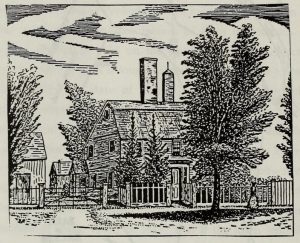
The accepted but not proven parents of Cassandra Burnell Southwick are Humphrey and Ann Burnell of Bearley, Warwickshire. This has seemed problematic to me for a number of reasons, primarily that Cassandra names none of her children Humphrey or Ann.
I started on a path to question this lineage by noting that the second known son of Cassandra and Lawrence Southwick is born in Kingswinford, not surviving to adulthood, and is named Ananias Southwick. Anianias is baptized 1 Sep 1627 and buried 17 Sep 1627. This unusual name will then reappear on one of the few early records of Lawrence Southwick in Salem when Ananias Conklin, Obadiah Holmes and Lawrence Southwick set aside 2 acres of land for one of the first glassworks in 1639.
Ananias Conklin is also from Kingswinford, where he baptizes the children in his family (Mary, Jeremy and Cornelius). The last baptism is in 1637, two years before the Salem record. We do not know the parents of Ananias, although some suspect he is the son of a William Conklin or it could be a George Conklin.
This uncommon name “Ananias” only appears on a few records in the Kingswinford region, which includes the town of Old Swinford:
C1617 Ananias Southwick s of Lawrence and CassandraC1618 Ananias Henslee s of Josua, glassblowerOldwinsfordC1613 Ananais Arche son of Thomas ArcheC1637 Cornelius Coclen son of Annumus
This region is the site of glassmaking, where the Henzey family plays a significant role. Joshua Henzey is the son of one Ananias Henzey from the Lorraine region of France, whose family would feature. While Ananias’ son is clearly there, he leaves his will in 1660, his father Ananias is not found in any extant records. But I believe he is the possible father of Cassandra.
Cassandra Burnell marries Lawrence Southwick of Kingswinford in 1623 in [...]
Read more...